Gather

If there is one image that sums up Christmas for many people it is the crèche. The scene at the manger that is being set up in churches and homes and communities around the world. At its heart, of course, is the baby lying in a manger, helpless and adored by all those gathered around, and it is this gathering which is such a powerful part of the story being told by the crèche. Shepherds in the field, angels hovering nearby, kings on their way from distant lands, and even the animals in a humble shed are gathering around this baby.

Something happens when people gather. It’s hard to measure, but science tells us about all kinds of health benefits associated with participating in a community which gathers around shared interests. There are potential downsides, I realize. Group-think and mob-rule have dangerous consequences, but when communities are welcoming and loving, the potential for good is unlimited. I remember hearing a story years ago about the aftermath of the devastating 2010 earthquake in Haiti. The people had left the rubble of their impoverished homes and gathered together to sing. Singing to create community when they had nothing else.

No one has spoken more eloquently or worked more elegantly to create community around the human voice than composer, arranger and conductor Alice Parker, who celebrates her 91st birthday tomorrow on December 16. She was interviewed by Krista Tippett on NPR’s On Being in an episode titled Singing is the Most Companionable of Arts which aired recently. In it she describes the human voice in choral singing as our best tool for discovering what emotions lay beneath the surface, for overcoming the differences among us in the kind of face-to-face way that is required to build understanding, and as a means of balancing intuition with the rationality that is overly glorified by our society.

But Parker says it so much better and listening to this interview is an hour well spent:

Alice Parker interview-“On Being”

I think there is a reason that choral singing is the predominant form of music-making at this time of year. Parker talks about the incredible space that exists, when we sing about our faith, between our human story and those things we cannot understand. Singing together gives us another way of gathering around the baby. Even the angels sang that night.

Sonya

  *   *   *   *   *

Where I’ll be:

November 27-January 1– organist/choir director at Christ Episcopal Church, Rockville, Maryland, while their Music Director is recuperating. (www.christchurchrockville.org)

December 14, 7:30 p.m. – concert with Zemer Chai, The Mansion at Strathmore. (http://www.zemerchai.org/upcoming-performances-cr3j)

December 13, 15, 16 – World Bank/IMF Chorus concerts, Magnificats by John Rutter and Johann Pachelbel for choir and orchestra. 1:00 p.m. (www.wbimfchorus.org/news)

December 17, 10:00 – Washington National Cathedral, Bethlehem Prayer Service, simulcast (https://cathedral.org/event/bethlehem-prayer-service)

* * * * *

This blog represents my attempt to put thoughts together on various things that seem to connect – in my mind anyway. More often than not new ideas first involve reaching back to what was and I can only hope that the prehistoric San cave painting at the top of this page inspires all kinds of new connections between old and new.
Morning and Mourning

(first published December 9, 2010)

The liturgical season of Advent, which began this past Sunday, beautifully mirrors the natural world around us. Plants and animals close in on themselves for a time of hibernation that is ultimately the sustenance needed for renewed vigor. In a similar way Christians are asked to quiet their minds and prepare for Christ’s coming. Images of dark and light abound in the readings and music, just as the light of day is most precious in its contrast to night’s darkness. The duality of Advent is represented as well in the comfort we are encouraged to feel when we hear about a Savior’s birth, contrasting with the discomfort of the prophets’ words. Comfort, comfort…you brood of vipers!

Like the Chinese philosophical concept of yin and yang, the contrary messages of Advent are interdependent.  The anticipation we have for the coming of Christ in the flesh, a baby in a manger, is paired with the coming of Christ at the end of time.  What do we have here, a beginning or an ending? Both?

There is an African-American spiritual that inadvertently reflects two possible mind-sets for this time of year. Taking its inspiration from the Gospel of Matthew 24:29-31*, My Lord, what a morning is sometimes written as My Lord, what a mourning. Slavery’s oral tradition obscures the song’s original meaning, but it isn’t a stretch to imagine that those who first gave voice to spirituals were closer to mourning.

Light and dark. Comforting words and admonitions. The joy of welcoming an infant Savior and the fear of being unprepared for God’s expectations of us. Morning and mourning. Each part of these pairings has something to teach us, but ultimately light, joy, comfort and morning will win, if we so choose.

Peace, Sonya

*Matthew: 24-31 (NRVS)

Immediately after the suffering of those days the sun will be darkened, and the moon will not give its light; the stars will fall from heaven, and the powers of heaven will be shaken.  Then the sign of the Son of Man will appear in heaven, and then all the tribes of the earth will mourn, and they will see the Son of Man coming on the clouds of heaven with power and great glory.  And he will send out his angels with a loud trumpet call, and they will gather his elect from the four winds, from on end of heaven to the other.

* * * * *

Where I’ll be:

November 27-January 1– organist/choir director at Christ Episcopal Church, Rockville, Maryland, while their Music Director is recuperating. (www.christchurchrockville.org)

December 14, 7:30 p.m. – concert with Zemer Chai, The Mansion at Strathmore. (http://www.zemerchai.org/upcoming-performances-cr3j)

December 13, 15, 16 – World Bank/IMF Chorus concerts, Magnificats by John Rutter and Johann Pachelbel for choir and orchestra. 1:00 p.m. (www.wbimfchorus.org/news)

December 17, 10:00 – Washington National Cathedral, Bethlehem Prayer Service, simulcast (https://cathedral.org/event/bethlehem-prayer-service)

* * * * *

This blog represents my attempt to put thoughts together on various things that seem to connect – in my mind anyway. More often than not new ideas first involve reaching back to what was and I can only hope that the prehistoric San cave painting at the top of this page inspires all kinds of new connections between old and new.


Carya

What began as an idea somewhere on the spectrum of “cute”, has become something much more meaningful to me.  I needed to come up with the name for a group of singers that a colleague and I are taking to sing at two cathedrals in England next summer.  Putting our names together – Carleen and Sonya – was the idea that kept coming back to me, and with my colleague’s permission, our little ensemble became The Carya Ensemble.

It seemed a good idea, though, to check that word out first with the source of all knowledge, Google.  Carya, I learned, is a botanical genus which includes hickory and pecan trees.  A particular characteristic of this genus is resiliency, and  I liked the idea of aligning myself with a concept I admire so much in plants and people alike.  I was surprised to learn that, though the word “resilient” dates back to the 17th century, it wasn’t used as a description for a desirable human characteristic until the 1970’s.  There are words like grit and determination that were perhaps used before, but something more is implied with resiliency. It suggests, in ways the other words don’t, a molding of thought and actions to fit circumstances out of our control.

Where does a person’s ability to be resilient come from?  In part, I believe, it is a skill we acquire when we have enough empathy to learn from all the small and big ways that the people around us show courage in their daily lives.  It develops in those who have enough faith to believe that “all shall be well” and the patience to wait out the “long arc of moral justice.” Perhaps most important of all, resilience abounds in those who are able to remember with some frequency to practice gratitude.

Carya has become something of a mantra for me.  I hear it in my mind’s ear and find comfort in the sound. I wish I could turn it into a greeting …or a blessing. “Carya,” I might say next time I see you. May you be resilient.

I chronicled my own journey on the road to resiliency in an article published in the November edition of The Journal of the Association of Anglican Musicians which you can read here: JAAM article

Carya!

Sonya

Time

Behold, I tell you a mystery; we shall not all sleep, but we shall all be changed in a moment, in the twinkling of an eye, at the last trumpet.

From the 15th chapter of I Corinthians and used by Handel in his Messiah, these are words that often echo through my brain and which have inspired a couple of different postings. Unlike music, which is ruled by timely precision – rhythms, meters, tempi – and unlike the world we live in where timing can be everything and time usually feels like a scarce and valuable commodity, these words imply a less concrete, more expansive sense of time.

Perhaps, like me, you have been sitting on Metro, waiting for the single track to become available so your train can move, when you hear the operator assuring passengers that we will be moving momentarily.  “In a moment” – a phrase of breathtaking elasticity.  The train conductor’s vague sense of time brought to my mind’s ear the words above from Messiah, sung of course by a rich baritone voice.

A humbling moment for me was in sixth grade when our creative writing teacher, an amazing woman named Frances Sandmel, asked our class to write about time.  I was stumped, completely and utterly drawing a blank.  My more clever classmates came up with wonderful ideas that Mrs. Sandmel then cobbled into a poem which we read as a class at a very 70’s kind of happening, with musicians from the Cincinnati Symphony Orchestra, in a garden at the William Howard Taft Museum. The essential idea of her creation was that time equals change.  My young classmates wrote about time as mold growing on bread and the instant between a soldier standing and falling to the ground after being shot (our world included a war in Vietnam on television every evening after all).  Of time as a baby becoming a grandmother.

In other words, time is a twinkling of an eye and also a moment, because change happens at the speed of light as often as it does over an expanse. We talk about time standing still, and time flying.  We experience time in slow motion and yet decades of our lives seem to go by in a flash.

I believe that God exists simultaneously in the past, present and future, and that we would do well to find ways of doing the same. Would that we could live with a deeper knowledge of our connections to the past, while having the energy to satisfy our present needs and desires, and at the same time fly on the wings of our hopes for the future.  Seeing time this way just might take some of the edge off of our worries about not having enough of it and allay our concerns when time isn’t moving fast enough for those things we care most about, whether personal matters or on issues of justice and social change.  Those times when we need help to remember that the arc of the moral universe is indeed long… but only in human terms.

No surprise that Bach provides some useful wisdom about time in his Cantata No. 106, Gottes Zeit ist der allerbest Zeit – God’s time is the best of all times.

Peace,
Sonya

* * * * *

Where I’ll be:

September 4 through November 20 – organist/choir director at Chevy Chase Presbyterian Church (1 Chevy Chase Circle, Washington, D.C.) while their Music Director is on sabbatical. http://www.chevychasepc.org

November 6 – 4:00, playing for John Rutter’s Requiem with the choir of All Saints Episcopal Church, Chevy Chase.

* * * * *

This blog represents my attempt to put thoughts together on various things that seem to connect – in my mind anyway. More often than not new ideas first involve reaching back to what was and I can only hope that the prehistoric San cave painting at the top of this page inspires all kinds of new connections between old and new.

Feel free to pass this message along to anyone who might be interested. You can simply subscribe (look for the “Subscribe” button at the top of the post) to get a reminder of new posts, or you can register with a user name and password in order to comment. If a community conversation comes out of this, all the better. We have so much to share and so much to be grateful for.


HOW DO YOU GET TO CARNEGIE HALL?

I met a renowned musician last week and we shared a laugh – one of those incredulous laughs that mask the fact that you actually want to cry – when he told me that he was asked by someone he was working for at the time why he had to practice so much. Hadn’t he already learned how to play his instrument? I had the same question asked of me several years ago by someone who really should have known better and I didn’t have a good comeback then, though I’ve thought of a thousand since. Should a professional athlete forgo practice and just show up for the games? Should a lawyer read up on new laws and court decisions or just wing it? Same for a doctor? And shouldn’t we all just be able to sit quietly in a comfortable seated position for extended prayer or meditation at any given moment?

There’s a reason we use the word “practice” for musicians and athletes, medical and legal professionals, and even yogis. Anything we want to do better requires us to practice, and these pursuits are lifelong commitments for many of us.

To practice something which we want to have as part of our lives was an idea brought to my mind again this week during a Rosh Hashanah service for which I was playing (I practiced quite a lot for it, by the way). The Rabbi talked about a practice he wanted to incorporate more fully into his life – that of thanking someone for the blessing of allowing him to perform a mitzvah, a word which can mean an act of kindness. He wants to make it a habit to thank those who allow him to be helpful.  Habits don’t become an integral part of our lives without practice.

Does anyone remember the bumper sticker that was quite popular in the late 1980’s which read: Practice random kindness and commit senseless acts of beauty?

These things don’t happen without practice. The practice of lifelong commitment to being and doing better.

Peace,
Sonya

* * * * *

Where I’ll be:

September 4 through November 20 – organist/choir director at Chevy Chase Presbyterian Church (1 Chevy Chase Circle, Washington, D.C.) while their Music Director is on sabbatical. http://www.chevychasepc.org

Also in October, I will be playing for the High Holy Days (a first for me) for the Bethesda Jewish Congregation.

November 6 – 4:00, playing for John Rutter’s Requiem with the choir of All Saints Episcopal Church, Chevy Chase.

* * * * *

This blog represents my attempt to put thoughts together on various things that seem to connect – in my mind anyway. More often than not new ideas first involve reaching back to what was and I can only hope that the prehistoric San cave painting at the top of this page inspires all kinds of new connections between old and new.

Feel free to pass this message along to anyone who might be interested. You can simply subscribe (look for the “Subscribe” button at the top of the post) to get a reminder of new posts, or you can register with a user name and password in order to comment. If a community conversation comes out of this, all the better. We have so much to share and so much to be grateful for.


1941

This past summer brought quite a lot of music with ties to World War II Europe into my life I noticed. This week, two pieces that I am preparing for a concert tomorrow –Variations on a theme of Paganini by Polish composer Witold Lutoslawski and a piece written by British composer Benjamin Britten in memory of Polish pianist and statesman Ignacy Paderewski, Mazurka elegiaca.

Two musical works with stories loosely connected emerged from the spring of 1941 as signs of art’s triumph over the hopelessness of war.  Lutoslawski wrote hundreds of arrangements for two pianos, which he and fellow Pole Andrez Panufnik played in the cafes of wartime Warsaw between 1940 and 1944. All of these compositions, except one, were destroyed during the Warsaw Uprising and are lost forever.  But Lutoslawski’s 1941 work, based on Paganini’s malleable tune from his 24th Caprice and used by so many other composers (including Rachmaninoff, Brahms, Liszt and even Andrew Lloyd Webber) found its way out of Poland and is much loved by piano duos.

Britten had an entirely different wartime experience.  He chose to leave England in 1939 and was harshly criticized for doing so.  He spent some of that time in California, where his publisher telegrammed him early in 1941 and asked for two piano pieces that would celebrate Paderewski’s long, multi-faceted career.  But Britten misunderstand his publisher’s request and wrote one two-piano piece, which, following Paderewski’s death in June of 1941, became a memorial work built on rhythms of the traditional Polish dance, the mazurka.  In its middle section, the confusion and turbulence of war seem to play out in music, causing one reviewer to describe the work as “a lament for Poland’s predicament: it’s tenderness is tinged with violence, and in the middle the piece seems to hang by a thread.”  But then, peace always hangs by a thread.

There were other bits of artistic news during that year of war.  The National Gallery of Art opened in Washington, D.C.  The film “Citizen Kane’ was released. And Billie Holliday recorded her song God Bless the Child.  With Holliday’s description of its obscure text as a song that came to her after fighting with her mother about money, there can only be speculation that the words are related to Luke 8:11-18 and the parable of the sower, as many have suggested.  God, so this story from the Gospels seems to imply, has sowed the seeds of divinity in each of us and our lives will be increasingly fruitful as we become increasingly aware of that holiness within ourselves.

Holliday’s own sad life serves to remind us that fame and fortune can’t possibly satisfy the deepest longings of our hearts.  Real happiness comes when our seeds of divinity bear the fruit of peace and quiet strength.  The biggest lesson of 1941 would come on December 7,  though, when this country learned it couldn’t turn its back on evil any longer.  Peace would have to wait.  Neither the quest for fame and fortune, nor the manipulations of power and domination could make anyone happy.

But if that’s just a bit too serious of an ending for this September day 75 years later, 1941 also brought us the first Curious George book.  God bless the child, and the magic of children’s books!

Peace,
Sonya

* * * * *

Where I’ll be:

September 4 through November 20 – organist/choir director at Chevy Chase Presbyterian Church (1 Chevy Chase Circle, Washington, D.C.) while their Music Director is on sabbatical. www.chevychasepc.org

Friday, September 9 at 7:30 p.m., Let’s Dance! Music for Two Pianos (no actual dancing is involved). Sophia Vastek and Sonya Sutton play music of Manual Infante, Witold Lutoslawski, Benjamin Britten and Sergei Rachmaninoff. We are raising money for The House of Ruth, an organization that helps women and children coming out of domestic violence and homelessness. We will match any gifts made at the concert to support their good work. Contact me directly if you would like to receive an invitation.

October 5 – Millennium Stage, Kennedy Center, 6:00 p.m., I will be playing on a program with Furia Flamenco and Guillermo Christie

Also in October, I will be playing for the High Holy Days (a first for me) for the Bethesda Jewish Congregation.

* * * * *

This blog represents my attempt to put thoughts together on various things that seem to connect – in my mind anyway. More often than not new ideas first involve reaching back to what was and I can only hope that the prehistoric San cave painting at the top of this page inspires all kinds of new connections between old and new.

Feel free to pass this message along to anyone who might be interested. You can simply subscribe (look for the “Subscribe” button at the top of the post) to get a reminder of new posts, or you can register with a user name and password in order to comment. If a community conversation comes out of this, all the better. We have so much to share and so much to be grateful for.

Tiny House, Big View

Today’s post is by guest blogger Sophia Vastek.  She last wrote about composer John Cage. This week, a heart-opening summer experience…

I spent four weeks in upstate New York this summer, participating in a month-long, multi-disciplinary workshop with architects, engineers, visual artists, writers, photographers, and filmmakers called Arts, Letters & Numbers. [ALN] I really had no idea what I was getting myself into when my partner and I agreed to help build a music program into this existing workshop.  It was often grueling, collaborative work – intimate but also lonely.  But I ended up learning so much about what it means to create and build.

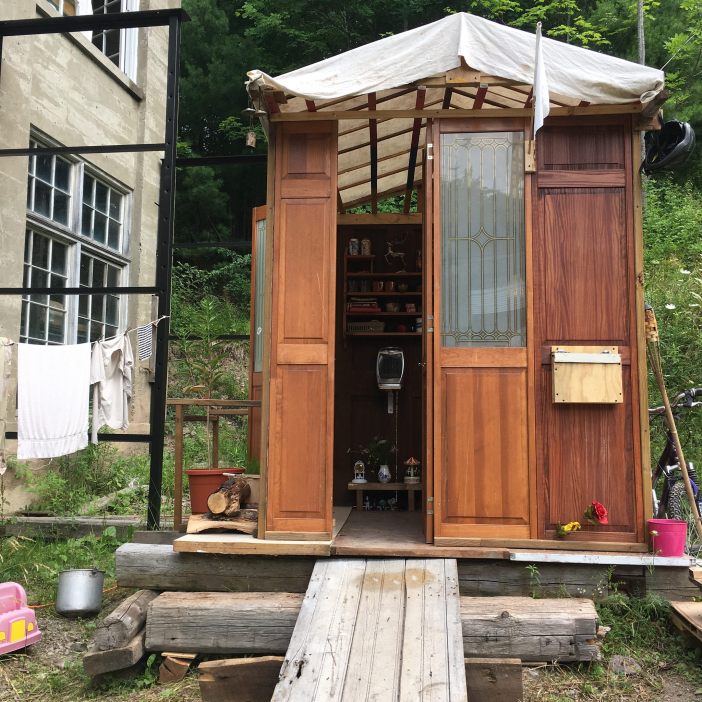
While we were there, one of the visiting artists – Bart Drost – built a tiny house (see the picture below).  He spent only a couple days building, and once finished, he invited every participant to come into his new space one by one and spend some time inside.  We weren’t told what we were going to do there.  I arrived at my scheduled time, admittedly a little apprehensive.  Some of the participants had been spending whole days inside this house…. He took me inside and sat me down at the desk, which occupied most of the floor space of the house. On the desk was a stack of paper and writing/drawing tools.  He gave me the simple task of drawing something that related to this idea: “A time when your outside was different from your inside.”  And then, with a huge smile, he told me, “everyone can draw!”

I spent about 3 hours inside his house, alone, thinking about that idea. Starting figuratively, moving towards the abstract. I ended up creating a small installation with string and cut paper, and when I was finished, I showed him my work.  He asked me what it meant, and I described the time after my father had died when I felt that I couldn’t grieve in public. My insides were quite different from my outside.  We had a beautiful conversation as I shared this most intimate story.  All in his tiny house.  

He did that with about 25 people. Imagine the stories he must have heard.

Once everyone had finished their time in his house, he put the art on display inside (anonymously) and opened it to the public.  The house was a witness to each of our stories.  And memorialized and celebrated them.  

He taught me so much through that experience.  That we need time alone, to sit quietly and meditate on our stories.  That we need time to manifest those stories. That we need time to create.  And most importantly, he taught me that everyone can create when given the right space.

At its heart, Arts Letters & Numbers is about creating a space where everyone is safe.  We all need spaces like these – places where people aren’t afraid to sing out loud, where people can cry publicly and without shame, where people can hold each other when they need to be held, where people can dance without fear of who’s watching, where people can create art without fear of the “critique”.  I realized as I was leaving that I am beyond privileged to have been a part of such an environment. And ultimately, I learned that I need to work hard to carry this forth – to create these kinds of spaces in my daily life in the “real world” for myself and for others.  

27963529643_5277722fab_k.jpg


* * * * *

Where I’ll be:

September 4 through November 20 – organist/choir director at Chevy Chase Presbyterian Church (1 Chevy Chase Circle, Washington, D.C.) while their Music Director is on sabbatical.

Friday, September 9 at 7:30 p.m., Let’s Dance! Music for Two Pianos (no actual dancing is involved). Sophia Vastek and Sonya Sutton play music of Manual Infante, Witold Lutoslawski, Benjamin Britten and Sergei Rachmaninoff.  We are raising money for The House of Ruth, an organization that helps women and children coming out of domestic violence and homelessness.  I will match your gifts to support their good work.Contact me directly if you would like to receive an invitation.

October 5 – Millennium Stage, Kennedy Center, 6:00 p.m., I will playing on a program with Furia Flamenco and Guillermo Christie

Also in October, I will be playing for the High Holy Days (a first for me) of the Bethesda Jewish Congregation.

* * * * *

This blog represents my attempt to put thoughts together on various things that seem to connect – in my mind anyway. More often than not new ideas first involve reaching back to what was and I can only hope that the prehistoric San cave painting at the top of this page inspires all kinds of new connections between old and new.

Feel free to pass this message along to anyone who might be interested. You can simply subscribe (look for the “Subscribe” button at the top of the post) to get a reminder of new posts, or you can register with a user name and password in order to comment. If a community conversation comes out of this, all the better. We have so much to share and so much to be grateful for.


Living History

This past week gave me the privilege of being in Canterbury, England as the organist for a friend’s choir during their fourth residency at a British cathedral. Christ Church, Glendale (Ohio) is an all-volunteer choir that has flourished for nearly 30 years under their director, Bryan Mock.  They sang traditional English cathedral music, including Finzi’s Lo, the full, final sacrifice, which I wrote about a few weeks ago. And as anyone who has done something like this knows, there is A LOT of music to prepare for a week’s worth of service at an Anglican cathedral. I got to hide out in Canterbury Cathedral’s organ loft, playing the music of Howells and Langlais and Bach, not to mention the anthems of Finzi and Elgar and Sumsion, just a few yards from the very spot where Thomas Becket was murdered in 1170.

Talk about living with history.

Just a year ago I traveled with a different choir to sing in the great churches of France, and where we held an emotional service of remembrance at the American Cemetery, near the landing beaches of Normandy.  This summer I visited the tunnels in the white cliffs of Dover and learned about their role in World War II, particularly the evacuation efforts that rescued more than 300,000 soldiers and refugees from Dunkirk.  So interesting to be on the other side of the English Channel this summer, seeing the countryside where the Battle of Hastings was fought after seeing that story depicted in the Bayeux Tapestry last summer.

As with the Finzi anthem (composed in 1946), the war’s effect on Britain was surely foremost in the mind of Herbert Howells when he wrote the organ piece Master Tallis’s Testament in 1940.  Perhaps writing as the Battle of Dunkirk was waged during May and June of that same year?  Was he trying to recall England’s great Renaissance glory during those darkest days?

I played this lovely piece as a prelude to Canterbury Cathedral’s Sunday Eucharist this week.  It’s one of several pieces that highlight the draw that the Tudor period had for Howells, and he created in this work his own testament to British culture. Sixteenth century sensibilities combine with twentieth century emotions to take the listener (and player) from the courtly to the anguished, overlaid with the British melancholy that colors so much of the music of Finzi, Britten and Vaughan Williams as well.  In fact, Master Tallis’s Testament surely owes much to Vaughan Williams.  An 18 year old Howells was at the 1910 Three Choirs Festival, sitting next to the composer during the premiere of Vaughan Williams’ orchestral piece Fantasia on a Theme of Thomas Tallis.

Two of my very favorite pieces are more deeply connected than I had realized:

Fantasia on a Theme of Thomas Tallis (Vaughan Williams)

Master Tallis’s Testament (Herbert Howells)

So many connections to make. The Battle of Hastings, the murder of an Archbishop of Canterbury, the flowering of English music and literature in the 16th century, the Three Choirs Festival of 1910, World War II, an American women in 2016 (“a lady organist! We don’t see very many of those,” so said a verger at Canterbury Cathedral). A few of the strands that create the tapestry of a life.  Some of the ways to live with history.

Peace,
Sonya

* * * * *

Where I’ll be:
August 14 – organist/choir director for the 10:00 am and 5:00 pm services at St. John’s (Norwood), 6701 Wisconsin Avenue, Chevy Chase, Maryland. Maybe you’d like to come and sing with the Summer Choir there? 9:15 a.m. rehearsal.

September 4 through November 20 – organist/choir director at Chevy Chase Presbyterian Church (1 Chevy Chase Circle, Washington, D.C.) while their Music Director is on sabbatical.

Save the Date: Friday, September 9 at 7:30 p.m., Let’s Dance! Music for Two Pianos (no actual dancing is involved). Sophia Vastek and Sonya Sutton play music of Manual Infante, Witold Lutoslawski, Benjamin Britten and Sergei Rachmaninoff. Contact me directly if you would like to receive an invitation.

* * * * *

This blog represents my attempt to put thoughts together on various things that seem to connect – in my mind anyway. More often than not new ideas first involve reaching back to what was and I can only hope that the prehistoric San cave painting at the top of this page inspires all kinds of new connections between old and new.

Feel free to pass this message along to anyone who might be interested. You can simply subscribe (look for the “Subscribe” button at the top of the post) to get a reminder of new posts, or you can register with a user name and password in order to comment. If a community conversation comes out of this, all the better. We have so much to share and so much to be grateful for.


No Mud, No Lotus

No mud, no lotus.  This thought from the Buddhist monk Thich Nhat Hanh should be the mantra for anyone going through difficult times.  God doesn’t purposely put us in the mud, I don’t think, but if we can observe, or even encourage, the lotus to emerge from it, then we have the possibility of happiness. I don’t really expect you to make the connection, but this is the thought that came to me while practicing the accompaniment for a piece that is new to me, Gerald Finzi’s Lo, the full, final sacrifice.  It’s a substantial and difficult piece for choir and organ, and the accompaniment was feeling muddy indeed.

I am still not quite hearing all of the beauty and power that this work promises, but there is one moment – one beautiful lotus – that emerged from the mud as I practiced.  It comes near the end, a few measures of such poignancy which spoke to me as clearly as any words could about longing for God’s presence. Beginning around 10:40 in this recording by the Truro Cathedral Choir, at the words come away (sweetly reminiscent, incidentally or not, of Shakespeare’s Twelfth Night song, “Come away death”):

Lo, the full, final sacrifice – Gerald Finzi

Finzi was avowedly agnostic and a pacifist.  Working in 1946, he set words of St. Thomas Aquinas, as translated by metaphysical poet Richard Crashaw (text is below). With its references to a ransomed Isaac (from the Biblical story of Abraham and Isaac) and the mythical assertion that pelicans would wound themselves in order to feed their own blood to their young, it is a text rich with the imagery of sacrifice. You might well imagine the potency of these images of sacrifice in post-war England. Traditional images of Christ as Paschal Lamb and Shepherd and simple references to food, bread and manna are woven together as well in this ode to the mystery of the Eucharist.  Agnostic?  Really?

Two different things came to mind as I was practicing the Finzi this week.  They might be related, but you would have to peek into my brain to help me figure out how. First, I heard a sermon this past Sunday which asked us to more fully embrace the line from The Lord’s Prayer, our daily bread.  The preacher spoke about our daily need for new bread.  Yesterday’s bread may have been good for that time, but might not be nourishing us anymore.  It was a suggestion to live more comfortably with change.  Second, I was reminded how a great ending can fully redeem even a mediocre story. Lo, the full, final sacrifice is a story of goodness coming from pain, of triumph over bleakness (though this is far from being a mediocre work, even if still muddy for me). It is the power of those final few minutes, I think, which redeems the jagged dissonances of the first 10 minutes.

A glorious ending.  Is that the connection?  Living comfortably with change so that we can move towards a glorious ending?  Living in the mud sometimes, so that the beauty of the lotus is all the more eloquent?

Lo, the full, final Sacrifice
On which all figures fix’t their eyes.
The ransomed Isaac, and his ram;
The Manna, and the Paschal Lamb.

Jesu Master, just and true!
Our Food, and faithful Shepherd too!

O let that love which thus makes thee
Mix with our low Mortality,
Lift our lean Souls, and set us up
Convictors of thine own full cup,
Coheirs of Saints. That so all may
Drink the same wine; and the same Way.
Nor change the Pasture, but the Place
To feed of Thee in thine own Face.

O dear Memorial of that Death
Which lives still, and allows us breath!
Rich, Royal food! Bountiful Bread!
Whose use denies us to the dead!

Live ever Bread of loves and be
My life, my soul, my surer self to me.

Help Lord, my Faith, my Hope increase;
And fill my portion in thy peace.
Give love for life; nor let my days
Grow, but in new powers to thy name and praise.

Rise, Royal Sion! rise and sing
Thy soul’s kind shepherd, thy heart’s King.
Stretch all thy powers; call if you can
Harps of heaven to hands of man.
This sovereign subject sits above
The best ambition of thy love.

Lo the Bread of Life, this day’s
Triumphant Text provokes thy praise.
The living and life-giving bread,
To the great Twelve distributed
When Life, himself, at point to die
Of love, was his own Legacy.

O soft self-wounding Pelican!
Whose breast weeps Balm for wounded man.
All this way bend thy benign flood
To a bleeding Heart that gasps for blood.
That blood, whose least drops sovereign be
To wash my worlds of sins from me.
Come love! Come Lord! and that long day
For which I languish, come away.
When this dry soul those eyes shall see,
And drink the unseal’d source of thee.
When Glory’s sun faith’s shades shall chase,
And for thy veil give me thy Face. Amen.

Peace,
Sonya

* * * * *

Where I’ll be:
July 31 and August 14 – organist/choir director for the 10:00 am and 5:00 pm services at St. John’s (Norwood), 6701 Wisconsin Avenue, Chevy Chase, Maryland. Maybe you’d like to come and sing with the Summer Choir there? 9:15 a.m. rehearsal.

July 31-August 12 – organist for Christ Church, Glendale (Ohio) during their residency at Canterbury Cathedral (U.K.)

September 4 through November 20 – organist/choir director at Chevy Chase Presbyterian Church (1 Chevy Chase Circle, Washington, D.C.) while their Music Director is on sabbatical.

Save the Date: Friday, September 9 at 7:30 p.m., Let’s Dance! Music for Two Pianos (no actual dancing is involved). Sophia Vastek and Sonya Sutton play music of Manual Infante, Witold Lutoslawski, Benjamin Britten and Sergei Rachmaninoff. Contact me directly if you would like to receive an invitation.

* * * * *

This blog represents my attempt to put thoughts together on various things that seem to connect – in my mind anyway. More often than not new ideas first involve reaching back to what was and I can only hope that the prehistoric San cave painting at the top of this page inspires all kinds of new connections between old and new.

Feel free to pass this message along to anyone who might be interested. You can simply subscribe (look for the “Subscribe” button at the top of the post) to get a reminder of new posts, or you can register with a user name and password in order to comment. If a community conversation comes out of this, all the better. We have so much to share and so much to be grateful for.

Sheer Silence

I love that idea…the sound of sheer silence.  These are words found in the Bible’s  1 Kings 19 which I was asked to read during a service at a conference a few years ago.  I enjoyed lingering over those words as I read them to a large group of musicians, who by and large appreciate silence more than most people.  There is the irony of silence having any sound of course.  And I like the word “sheer”, which could be synonymous with “utter” or “complete”, but could also have a hint of the word’s other meaning as something transparent, allowing light to come through.

I’ve written before about the potential for understanding that comes with silence – during a pause at the asterisk in psalms or during meditation.  We hear so much in the silence. Musically, it is the rests that give power and shape to the notes.  Musicians know that a musical rest is anything but restful.  Something is happening during that time – the music gathers force  from, or empties into, a rest.

It’s a phrase that also calls up for anyone of a certain age the 1966 Simon and Garfunkle hit song The Sounds of Silence.  The silence of those lyrics becomes something ominous, a sign of complicity, and that’s the silence that Elie Wiesel, Holocaust survivor and author, wrote about.  His obituary in The Washington Post on July 5 began by saying that no one was better able to grasp “the terrible power of silence…He understood that the failure to speak out, about both the horrors of the past and the evils of the present, is one of the most effective ways there is to perpetuate suffering and empower those who inflict it.”

But he saw the possibilities for silence to be useful too.  In a 1996 interview Wiesel said: You can be a silent witness, which means silence itself can become a way of communication. There is so much in silence. There is an archeology of silence. There is a geography of silence. There is a theology of silence. There is a history of silence. Silence is universal and you can work within it, within its own parameters and its own context, and make that silence into a testimony. Job was silent after he lost his children and everything, his fortune and his health. Job, for seven days and seven nights he was silent, and his three friends who came to visit him were also silent. That must have been a powerful silence, a brilliant silence. You see, silence itself can be testimony and I was waiting for ten years [to speak out about his experiences in the Holocaust], really, but it wasn’t the intention. My intention simply was to be sure that the words I would use are the proper words. I was afraid of language. 

Wiesel made the case for silence, and more specifically, people’s despair at God’s silence in the face of suffering, as proof of God’s existence. In our protests against that silence he found the potential for redemption. With all of the chatter that surrounds us now, competing for our attention and sometimes confusing us with inaccurate or twisted information, living with some silence might be welcome.

How do we move then towards the sheer silence that allows the light of understanding to come through the powerful, brilliant silence Weisel wrote about?  And move us away from the silence of fear or disbelief or complicity?  Are we brave enough to seek the silence that creates the space we need to actually hear what has been said? A silence that just might help us find the courageous words we need to say?

Peace.
Sonya

* * * * *

Where I’ll be:
June 12 through August 14 – organist/choir director for the 10:00 am and 5:00 pm services at St. John’s (Norwood), 6701 Wisconsin Avenue, Chevy Chase, Maryland. Maybe you’d like to come and sing with the Summer Choir there? 9:15 a.m. rehearsal.

July 31-August 12 – organist for Christ Church, Glendale (Ohio) during their residency at Canterbury Cathedral (U.K.)

September 4 through November 20 – organist/choir director at Chevy Chase Presbyterian Church (1 Chevy Chase Circle, Washington, D.C.) while their Music Director is on sabbatical.

Save the Date: Friday, September 9 at 7:30 p.m., Let’s Dance! Music for Two Pianos (no actual dancing is involved). Sophia Vastek and Sonya Sutton play music of Manual Infante, Witold Lutoslawski, Benjamin Britten and Sergei Rachmaninoff. Contact me directly if you would like to receive an invitation.

* * * * *

This blog represents my attempt to put thoughts together on various things that seem to connect – in my mind anyway. More often than not new ideas first involve reaching back to what was and I can only hope that the prehistoric San cave painting at the top of this page inspires all kinds of new connections between old and new.

Feel free to pass this message along to anyone who might be interested. You can simply subscribe (look for the “Subscribe” button at the top of the post) to get a reminder of new posts, or you can register with a user name and password in order to comment. If a community conversation comes out of this, all the better. We have so much to share and so much to be grateful for.