Joy

Where do you find joy, when so much right now seems joyless? The news, and the traffic, and stresses of modern life, together with all of our fears about global warming and warring factions and humanity’s willful cruelties conspire to rob us of joy. We could turn off the news and stick our heads in the sand, but ignorance doesn’t bring joy. We could shut down conversations and proclaim that the other side is wrong, but disconnecting from relationships doesn’t bring joy. We could sweep unpleasantness under the rug and hope no one notices the lumps, but evading truth doesn’t bring joy. So where do we find joy?

A few years ago I came across a story about a 110 year old Holocaust survivor and pianist, Alice Herz-Sommer, who died in 2014, just a few days before a short film about her, The Lady in No. 6, won an Academy Award.  In accepting the Oscar, the film’s director, Malcolm Clarke, said that he was struck by Herz-Sommer’s “extraordinary capacity for joy” and “amazing capacity for forgiveness.”

In the midst of an insanity that would cause most of us to lose hope – a family torn apart, a husband sent to Dachau, she and her son to Theresienstadt – she found joy in music.  “Beethoven is my religion” she said.  “He gives me faith to live and to say to me: Life is wonderful and worthwhile, even when it is difficult.”  She credited Chopin with keeping her alive in the camp, as she pulled upon the reserve of strength which Chopin’s etudes had built within her.

Alice had every reason to lose hope, and instead found every reason to hold onto it.  If her choice to find beauty and joy in a harsh world seems naïve, does feeling damaged, angry or vengeful seem like a better choice?

“It is up to us whether we look at the good or the bad. When you are nice to others, they are nice to you. When you give, you receive.” Simple words from a Jewish Holocaust survivor, so very reminiscent of another Jew, as recorded in the Gospel according to Mark.

“Music is God,” Alice tells us in the film. What is beautiful is of God. She believed in the power of music, and believed that being joyful is a choice which any of us can make. At her darkest hour, she chose to look for beauty, and in finding it where she could, hope was possible.

Where there is hope there can be joy. Leonard Cohen reminded us that “there is a crack in everything, that’s how the light gets in.” I doubt that Alice was blind to the horror around her, and if we are living in times which seem to encourage ignorance, disconnectedness, and evasion of responsibility and truth, look for those cracks where the light gets in and just maybe that is where your joy can be found.

Peace,
Sonya

2014 Oscar winning short documentary

* * * * *

This blog represents my attempt to put thoughts together on various things that seem to connect – in my mind anyway. More often than not new ideas first involve reaching back to what was and I can only hope that the prehistoric San cave painting at the top of this page inspires all kinds of new connections between old and new.

Feel free to pass this message along to anyone who might be interested. You can simply subscribe (look for the “Subscribe” button at the top of the post) to get a reminder of new posts, or you can register with a user name and password in order to comment. If a community conversation comes out of this, all the better. We have so much to share and so much for which we can be grateful.
 

Barley

Barley is probably my favorite grain – and not because it’s a key ingredient in beer and whiskey, neither of which I like at all. I frequently use this ancient grain in soups and stews, but even so, I was very surprised to have the word “barley” stare me in the face not once, but twice one afternoon recently. What are the chances that the word “barley” comes into your life twice in the same day, in ways completely unrelated to the actual food?

While reading an article about the hymns of Richard Wayne Dirksen before writing my post last week, I learned the story behind Dirksen’s hymn tune BARLEY.  It’s not found in The Hymnal 1982 unfortunately, but I had come across the tune in a choral hymn setting titled Praise the Spirit in Creation several years ago, and I find the tune as hearty and satisfying as its grain namesake. Dirksen named it, I learned, after Mr. Barley, the Great Cat. The Dirksens had adopted a bedraggled foundling one rainy evening, and several years later when the composer was pondering a name for a new tune he had written for the American Guild of Organist’s 1992 convention, he came back to his computer to find that Barley had stood on the keyboard as he crossed to the window for some squirrel-watching.  No, the cat hadn’t typed the word “barley.”  You didn’t really think that, did you? But Mr. Dirksen saw a feline equivalent in the six “k’s” that he found on his computer screen and promptly named his new tune with six other letters – BARLEY.  You can hear the choirs of Washington National Cathedral singing it here.

Barley made a second appearance when a neighbor emailed to share that she was completely taken with a new album, one by an artist I probably would not have heard about otherwise, Lizz Wright. Hers is an earthy, honest voice, more than worthy of the earthy, honest grain she sings about in the song “Barley,” found on her new album, Grace.  It’s a text that speaks of resilience, strength, and moving forward.

The wind that shakes the barley will not shake me
The fire that takes the kindling will not take me
And the rain that floods the valley will not drown me
The hawk that stoops the sparrow will not strike me
The dark before the dawn breaks will not bind me
The wind that shakes the barley will not shake me
Like my mama told me, this I know when I see.

The musical layers of barley. Who knew?

Peace,
Sonya

* * * * *

This blog represents my attempt to put thoughts together on various things that seem to connect – in my mind anyway. More often than not new ideas first involve reaching back to what was and I can only hope that the prehistoric San cave painting at the top of this page inspires all kinds of new connections between old and new.

Feel free to pass this message along to anyone who might be interested. You can simply subscribe (look for the “Subscribe” button at the top of the post) to get a reminder of new posts, or you can register with a user name and password in order to comment. If a community conversation comes out of this, all the better. We have so much to share and so much for which we can be grateful.

Enthusiasm

Addressing the French Academy of Sciences in 1882, Louis Pasteur quoted an unnamed philosopher who had written: “I have thought for a long time that the person who has only clear and precise ideas must assuredly be a fool. For the most precious notions harbored by human intelligence are deeply behind-the-scene and in semi-daylight, and it is around these confused ideas, whose interrelations escape us, that the clear ideas gravitate, extending, developing, and germinating themselves.”

Pasteur then continued: “If we were cut off from this background, the exact sciences would lose the greatness which they draw from the secret rapport they hold with those infinite truths whose existence we can only suspect.”

A secret rapport between infinite truth and exact science…that sounds like the perfect religion to me. Writing in 2002 about his process for composing hymns, Richard Wayne Dirksen further quoted Pasteur:

The Greeks understood the hidden power of things infinite.  They bequeathed to us one of the most beautiful words in our language – the word “enthusiasm” – en theos – a God within.  The grandeur of human actions is measured by the inspiration from which they spring.  Happy is [the one] who bears a god within and who obeys it.  The ideals of art, of science, are lighted by reflections from the infinite.

Knowing that the word enthusiasm has its roots in the Greek for God, theos, completely changes the meaning for me. It was a word which had vaguely reminded me of Mickey Rooney and Judy Garland determined to put on a show against all odds. Enthusiasm seemed to require multiple exclamation points!! My obvious joy in music-making for the church has often been described as enthusiastic, and I will now wear the mantle of enthusiasm with some pride. I see that it is a word which describes a divinely inspired joy. Exclamation points optional.

Dirksen continued: “My succinct perspective is this: when people sing together, that enthusiasm within each engenders a community-wide awareness of those reflections from the infinite. The sharing of a God within through making music puts us in unison touch with the infinite God, and intensifies our knowledge of and enthusiasm for [God]. Collectively, do we therefore embody and live our theology.”

Accessing the hidden power of things infinite by singing hymns…I believe in that. Great hymn writers, like Dirksen, know that a great hymn begins with the text. The words guide the tune’s creation and give the hymn its character. Writing online for National Public Radio, critic Juan Vidal examined his own surprising encounter with traditional hymnody as a young man:

It would do us good to revisit some of the poetry of a time so different than our own. These old texts merit our attention; for me they carry the same resonance as Shakespeare. Not only are they rich in history, they also draw us to appreciate the wonder of words. Instead of viewing the vocabulary as archaic, I’ve come to see hymns as the language of prayer, and as a way of connecting with those that have come before me.

Could anything be more important right now than connecting with others? Connecting with people next to us and those who came before? When we sing a great hymn – one with evocative imagery and bold ideas, one with a tune that moves us and perhaps surprises us too – we probably aren’t aware that we may be surrounded in that moment by people who look different from us, or belong to a different political party, or believe in things which we find uncomfortable. During a time of shared singing we are given an opportunity to simply expose our enthusiasm as a place where our best selves can germinate.  Happy new year.(!)

Peace,
Sonya

* * * * *

This blog represents my attempt to put thoughts together on various things that seem to connect – in my mind anyway. More often than not new ideas first involve reaching back to what was and I can only hope that the prehistoric San cave painting at the top of this page inspires all kinds of new connections between old and new.

Feel free to pass this message along to anyone who might be interested. You can simply subscribe (look for the “Subscribe” button at the top of the post) to get a reminder of new posts, or you can register with a user name and password in order to comment. If a community conversation comes out of this, all the better. We have so much to share and so much for which we can be grateful.

Advent 4 – Veni Emmanuel

This week contains the shortest days of the year, as well as one last opportunity to ponder the season of Advent. This is the turning point. Days now begin to gradually lengthen, and that for which we are waiting will soon be with us. In my mind’s ear I hear the bass soloist in  Handel’s Messiah singing:

For behold, darkness shall cover the earth…the people that walked in darkness have seen a great light; and they that dwell in the land of the shadow of death, upon them hath the light shined.

I was probably well into early adulthood before I realized that it was actually the prophet Isaiah, and not Handel, who wrote about this time of darkness and the coming of a great light.

There is one hymn in particular which captures the urgency of our longing – for light, for salvation, for hope, for knowledge, for connection. O come, O come Emmanuel, expresses all that Advent holds for us, and takes us to a place of contemplation and quiet anticipation. Its medieval text and tune – written separately and of uncertain sources – are mysterious and comforting at the same time.

These “O” antiphons, as the words are known, are adaptations of medieval texts that were (and still are in some places) sung before and after the chanting of the Magnificat, one each in the seven days preceding Christmas Eve. Perhaps you’ve always wondered what those dates before each verse of Hymn #56 in The Hymnal 1982 meant?

Each of the seven different verses of Veni Emmanuel begins with a salutation in the form of a name for God, and then a petition based on that name:

(December 17) O Sapienta
O come, thou Wisdom, to us the path of knowledge show
(December 18)  O Adonai
O come, thou Lord of might, that didst give the law
(December 19)  O Radix Jesse
O come, thou Branch of Jesse’s tree, give them victory o’er the grave
(December 20)  O Clavis David
O come, thou Key of David, make safe the way that leads on high
(December 21)  O Oriens
O come, thou Dayspring from on high, disperse the gloomy clouds of night
(December 22)  O Rex gentium
O come, Desire of nations, be thyself our King of Peace
(December 23)  O Emmanuel
O come, Emmanuel and ransom captive Israel

My soul proclaims the greatness of the Lord and my spirit rejoices in God my savior, the first line of the Magnificat, is Mary’s marvelous response to Gabriel’s news that she would bear a son. If only we were all able to be as open-hearted and accepting of God’s plan for us. With each verse of O come, O come Emmanuel we are summoning God into our lives, but there needs to be room in our hearts for all the ways that God might open our minds and cause us to change.

The duality of Advent includes the knowledge that we are awaiting something which we already have – God’s love. Light and dark, joy and penance, a baby both human and divine. The very word Emmanuel, Hebrew for “God with us,” suggests reality, however, and not just a hope. We sing our invitation with Veni Emmanuel. Be ready then to make room.

Veni Emmanuel – instrumental version, with photos from the Holy Land

Peace,
Sonya

Advent 3 – Carols

In his Preface to The Oxford Book of Carols, Percy Dearmer, one of the editors of that  collection, begins with a description of carols that I simply cannot top: Carols are songs with a religious impulse that are simple, hilarious, popular, and modern. With roots in the country dances of 15th and 16th century Europe, the hilarity of hard-working people at play is sometimes quite evident in the carols we still sing, such as God rest you merry, gentlemen…Good Christian friends, rejoice…Deck the halls.  

The medieval “miracle” plays of 14th and 15th century England – so-called because they dramatized the miracles and momentous events of Christ’s incarnation and life – were an early source of songs about Christ’s birth written in the vernacular. Performed outside the church by members of the various guilds, livelier dance tunes eventually replaced more serious forms of church-approved music. Carols were born from that great flowering of humanism in the 15th century, as a reaction to the contemplative plainsong of the Church and heavy-handed theological thinking which frowned on joy. Because carols were linked to dance music, they were regarded with some suspicion by church leaders and then abolished by Cromwell in 1647.

Carols remained an underground form of music-making by rural folks during the puritanical 17th and 18th centuries, but singing them was almost extinct by the time Charles Dickens published A Christmas Carol in 1843. The word “carol” had come to signify Christmas poems and stories without music. It was the discovery in 1852 of a medieval Swedish book, the Piae Cantiones, from which we have several popular carols today, together with a growing appreciation and scientific interest in collecting folk music in the late 19th century, which gave impetus to the revival of carol singing.

Carols are simple and popular, so says Dearmer in his extended preface to what is an invaluable source of Christmas carols, because “the typical carol gives voice to the common emotions of healthy people in language that can be understood and music that can be shared by all.”

But modern? We don’t usually think about carols as an expression of current times, yet anything which lasts for hundreds of years expresses in some way the timeless ideas of its own age. A 19th century American carol, It came upon a midnight clear, found in The Hymnal 1982 at #89, was authored by a Unitarian minister for a population on the brink of civil war. He didn’t write about the birth of Christ, but rather about angels and “Peace on the earth, goodwill to men.”  And then, in verse 3:

Yet with the woes of sin and strife the world has suffered long,
beneath the heavenly hymn have rolled two thousand years of wrong;
and warring humankind hears not the tidings which they bring;
O hush the noise and cease your strife and hear the angels sing!

Hardly hilarious, but sadly timeless.

It’s not always easy, and never really necessary, to make a clear distinction between hymns and carols, but one broadly stated difference could be that the tune takes precedence in carols, and the text does so in hymns.  Or perhaps carols could be defined by their danceability!

Percy Dearmer ends his preface, written in 1928, with yet more quotable words: Perhaps nothing is just now of such importance as to increase the element of joy in religion; people crowd in our churches at the Christmas and Easter Festivals, largely because the hymns for those occasions are full of a sound hilarity.

Sound hilarity. That is something to which we might aspire in our carol singing!

Peace,
Sonya

Advent 2 – Dichotomy

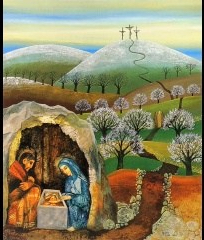
This painting by German artist Beate Heinen captures for me the dual nature of Advent, the liturgical season which begins the church year with four Sundays preceding Christmas. During this time we arManger and Cross, Beate Heinene called to joy and penance in equal measure.  It is a season which reflects the darkness of the natural world and the candles of our inner light, beginnings and end times, the comfort of God’s word and the discomfort of the prophets’ words which we hear in the readings throughout these four Sundays of Advent.

“Manger and the Cross” is the painting’s title, and both of those symbols of our faith reveal God’s love for us. I find beauty in its complete representation of the story we begin each Advent, and as I look at it I am reminded of a poem I discovered some years ago as a text for a piece of music. Though I find the poem incredibly moving, I’ve never found quite the right time to program a song which is planted so firmly in both Advent and Lent. The words are by Dorothy Parker, the American poet best known for her wit and wisecracks.

Prayer for a New Mother

The things she knew, let her forget again-
The voices in the sky, the fear, the cold,
The gaping shepherds, and the queer old men
Piling their clumsy gifts of foreign gold.

Let her have laughter with her little one;
Teach her the endless, tuneless songs to sing,
Grant her her right to whisper to her son
The foolish names one dare not call a king.

Keep from her dreams the rumble of a crowd,
The smell of rough-cut wood, the trail of red,
The thick and chilly whiteness of the shroud
That wraps the strange new body of the dead.

Ah, let her go, kind Lord, where mothers go
And boast his pretty words and ways, and plan
The proud and happy years that they shall know
Together, when her son is grown a man.


May you find these weeks of Advent to be a time of comfort and discomfort, joy and penance, questions and answers, a time of resting and a time of moving towards light and rebirth.  And as Parker hopes for Mary, a time of learning how to let laughter and dreams triumph over our knowledge of life’s dark places.

Peace,
Sonya

Advent 1 – Anticipation

You are invited to a service of Advent Lessons and Carols
 Sunday, December 3 at 5:00       St. John’s, Norwood
Music and readings for a time of anticipation

The season of Advent is, above all, a time of watching and waiting for the coming of the kingdom of God. Science tells us that it is anticipation of reward, and not the reward itself, which causes dopamine to be released in our brains, so a reflective time of preparation may have even more value than we realize. While there is a sense of restraint and watchfulness during any time of anticipation, we have the luxury of also feeling a confident joy as Christmas approaches. We happen to know that this time of waiting ends with the birth of a baby who changes the world.

This story of prophecies and promises fulfilled plays out in the context of a single Lessons and Carols service this Sunday afternoon, as well as across the four Sundays of Advent. Churches all over the world base their services of Lessons and Carols on the celebrated Christmas Eve service at King’s College, Cambridge, which traditionally begins with the single voice of a young chorister singing the first verse of Once in royal David’s city. Fear not, there will be plenty of traditional carols during the season of Christmas, but this Sunday’s 5:00 pm service of Lessons and Carols requires something different than the carols of Christmas. We’ll sing music of this season, the Advent season, and not the songs of mall shopping and popular culture. Together with the lessons, this is a service which seeks to nurture anticipation in each of us.

The Power of Story

Where do mystery and reason meet? One might argue, and certainly Joseph Campbell did so in his book and 1988 television series “The Power of Myth,” that they meet in theology. Both mystery and reason attempt, in their own ways, to illuminate truths of who we are and what we believe. It seems to me that, unlike reason, mystery’s truths cannot be defined solely by our five senses, however, and that, I think, gives more power to the stories we tell – stories about lamps needing oil and voices in the wilderness and angels bringing surprising news. Like music, the mysteries of faith take us to truths that are best expressed in feelings which go beyond words. Feelings of hope, inclusion, wonder, comfort, longing, anticipation…

Peace,
Sonya

The Moment to Decide

Thou that hast given so much to me
give one thing more, a grateful heart.
Not thankful when it pleaseth me,
as if Thy blessings had spare days —
but such a heart, whose pulse may be Thy praise.

from “Gratefulness” by George Herbert

Cultivating, expressing, and living a life of gratitude are decisions we each make for ourselves. Feeling grateful can come from a place of abundance in our lives, but I have a feeling it comes more often from a place of scarcity, or even despair. Those moments when we are stripped down to a basic level of survival – be that emotional or physical survival – and we somehow summon gratitude for another day, a kindness shown, or even just an awareness that our pain is a sign that we have loved and been loved. These are clear connections with God in a way that lifts us from scarcity to abundance.

Think of all that you are blessed with.  A loving family? Educational opportunities? The chance to travel the world? Material wealth? Good health? Sincere friendships?  Resilience?  Charisma? The possibilities are many.  The best gifts are given without expectation of anything in return, but blessings? Those put us in God’s debt and we do owe something back to the world for our blessings.

President Kennedy, echoing words from Luke 12:48, reminded a prosperous America in 1961: “For of those to whom much is given, much is required.”

 *   *   *   *   *

Three people in the past week or so have individually mentioned the same hymn to me. Coincidence?  Holy Spirit?  It comes from The Hymnal 1940, and though I know the tune well (the wonderfully sturdy Welsh tune, supposedly found in a bottle on its rugged coastline…Ton-y-botel), the words were less familiar to me.  I suppose the editorial committee for The Hymnal 1982 couldn’t imagine us singing these words into the 21st century and so it didn’t make the cut:

Once to every man and nation comes the moment to decide,
In the strife of truth with falsehood, for the good or evil side;
Some great cause, God’s new Messiah, off’ring each the bloom or blight,
And the choice goes by forever ‘twixt that darkness and that light.

From a poem written to protest the Mexican War and the increased territory for slavery which that war portended, the hymn’s text continues:

Then the brave man chooses, while the coward stands aside till the multitude make virtue of the faith they had denied (v. 2), and …toiling up new Calvaries ever with the cross that turns not back; new occasions teach new duties, time makes ancient good uncouth (v. 3) and in the final verse…Though the cause of evil prosper, yet ’tis truth alone is strong.  

You will find the text in its entirety here. Do you agree that these words have relevance for us in 2017, occasional masculine language notwithstanding? New CalvariesGod’s new Messiah…new occasions teach new duties…new forms of human cruelty and deception, new reasons to strengthen our resolve for truth and justice.

This is bold language, words to shake us from complacency.  Perhaps too directive though, too black and white? But aren’t some things simply wrong? Is every problem shaded in gray? If a simple question were to be asked of any action – does it create more goodwill and love in the world? – would that pull us out of some of life’s gray areas?

Each of us has abundant blessings of one kind or another. Our obligation in turn is to see each decision – even seemingly insignificant ones – as moments to decide ‘twixt that darkness and that light.

With a grateful heart,
Sonya

Sanctus…Some Free Associations

A couple of years ago I had the pleasure of coaching an excellent, 100+ voice high school choir from Pennsylvania as they prepared to sing in a competition. One of the pieces they sang for me was a setting of the liturgical text Sanctus (Holy, holy, holy) by a young Norwegian-American composer, Ola Gjeilo.

I asked if the students knew what they were singing, and a few did know that Sanctus translated as “holy.”  No one, however, connected the elaborate setting they were singing in performance to anything that might be sung in church every week, though more than a few were undoubtedly also singing in their church choirs. I found myself explaining that the richness of the chords they were singing in the Gjeilo setting were a wonderful representation of this central part of our liturgy, when the people join their minds and hearts and voices together with the “Angels and Archangels and all the company of heaven.”  Maybe I crossed some church vs state line that I shouldn’t have, but a deeper understanding seemed worth that risk.

As I further reflected on this notion of the Sanctus as a point of convergence, I saw that moment in the liturgy as one where heaven and earth come together, giving us a glimpse of true communion. Liturgy emerged from my imagination in an hourglass shape – something akin to a George Herbert poem.

Coming from every direction, the people gather in church
Liturgy of the word and sermon
Creed and Prayers
Offertory
Sanctus
Eucharistic Prayer
The people partake in communion
Renewed and fed, the people disperse into the world

If you know the works of George Herbert, then you may already have made the same free association that I did with The Altar. The “metaphysical” poets, as a number of 17th century English poets, including George Herbert, are labeled, sought to describe reality beyond what science had to teach them.  They were particularly interested in illuminating God’s relationship to humans. In The Altar, the appearance of the poem as a physical ALTAR, upon reading describes the human HEART as altar. One made of stone that is “cut” by the power of God, leading to the death of selfish will as a SACRIFICE upon this ALTAR.

A broken ALTAR, Lord thy servant rears,
Made of a heart, and cemented with teares:
Whose parts are as thy hand did frame;
No workmans tool hath touch’d the same
A HEART alone
Is such a stone,
As nothing but
Thy pow’r doth cut.
Wherefore each part
Of my hard heart
Meets in this frame,
To praise thy Name:
That if I chance to hold my peace,
These stones to praise thee may not cease.
O let thy blessed SACRIFICE be mine,
And sanctifie this ALTAR to be thine.

Since I’ve already made a free association between the Sanctus and George Herbert, I’ll continue with a few more. From the poem’s second line:

…cemented with teares

My engineer/poet/philosopher father wrote his dissertation on concrete, so I happen to know that concrete must be kept wet in order to properly cure.  In that same way, tears strengthen the emotions we feel. Whether these are moments of sadness or happiness, love and compassion are strengthened when tears are present.

When Jesus wept, the falling tear in mercy flowed beyond all bound

Early American composer William Billings wrote a tune for these words that paints “falling tears” as clearly as Herbert draws his Altar above.  That tune is found in The Hymnal 1982 at #715, and it is beautifully used by 20th century American composer William Schuman in his New England Triptych..

I’ve come a long way from Sanctus, but our journeys are rarely in straight lines!

Peace,
Sonya

Hymnal Studies: Language Matters

The Once and Future Hymnal was the title of a conference I attended a few weeks ago at Virginia Theological Seminary. Though I don’t think there was any intention to make a connection with T.H. White’s fantasy novel about King Arthur, exploring human nature in connection with justice and power may well be a common theme between Episcopal hymnody and The Once and Future King. That would be something, however, to explore another day!

It was a privilege to step out of my routine and gather with colleagues from around the country, both clergy and musicians, to think about the Episcopal hymnal. Beyond privilege, it was a pleasure to hear from some of the original members of the planning committee for The Hymnal 1982, as well as from those who worked on the hymnals that have been put out more recently by the Presbyterian and Lutheran churches. The Reverend Frank Wade spoke to us about some of the changes the Episcopal Church has lived through since 1982, leaving it to the musicians in the room to figure out how those changes might have influenced what we sing.

The biggest take-away for me, and many that I talked to there, seemed to be an agreement that The Hymnal 1982 remains a valuable resource for the Episcopal Church, with gifts still to be explored by many churches. The hymnal’s General Editor, Ray Glover, established a guiding principle that “we should always be able to sing what we believe and believe what we sing.” That editorial committee, which worked for more than a decade, took some risks by including a few more experimental hymns, but, with rare exception, it is indeed a book which allows us to sing what we believe, even 35 years later.

This conference was a celebration of word more than of music, however. The Episcopal Church, we were reminded, prizes questions over answers, and language in the church is most valuable when it provides access to the mystery of faith, not answers. Church at its best gives us language to deal with uncertainty, and is likely one of the few places in our culture where mystery is valued.

One of the speakers, poet and hymn writer Susan Cherwien asks herself four questions as she is writing: Is it true? Is it beautiful? Is it excellent? Does it glorify God? What are we singing out into the world, she wonders. Is it about compassion, nobility, God’s beautiful creation? She cited scientific studies which found that the part of our brains connected to smell light up when we are simply reading about a scent. Other places in the brain connected to physical activity light up when reading about running. Language matters.

Language matters to the point that even a preposition can make all the difference. Frank Wade talked about the single resolution on diversity which came out of the 1976 General Convention. That resolution expressed the belief that the Episcopal Church should endeavor to minister more fully “to” people from diverse backgrounds. Oh my, how patronizing.

Carl Daw, Episcopal priest and acclaimed author of many hymn texts, warned about the dangers of using language as a weapon instead of a tool. Those times when words are used to diminish people, which can get into the tricky area of gender-based language…definitely a topic for another day. He mused, as well, on the word “Lord.” A troublesome word in today’s enlightened recognition of all the ways that patriarchal hierarchy has not served us well. He wishes we would look more deeply at our words and reclaim some of their original meanings. So many words fall into that category: Anglican, traditional, conservative…just to name a few. “Lord,” he told us, comes from an Anglo-Saxon word meaning “loaf warden.” The keeper of the bread. One who provides.

We were cautioned about music’s ability to hide the venom inherent in some language. Frank Wade wonders why we sing some of the wrath-filled psalms that we do, without explaining them to our congregations. Good point. Singing a refined Anglican chant setting of Psalm 149:6-9 only serves to soften a harshness I don’t think we believe. Again, we should be able to sing what we believe, and believe what we sing.

This conference was a very preliminary conversation, one that simply wondered about all that goes into planning a new hymnal, without any intent to actually begin that planning. A new hymnal for the Episcopal Church is something, by the way, which can’t happen until there is a new Book of Common Prayer, and I suggest we not hold our collective breath waiting for that to happen.

Why have a hymnal at all? How about having iPads in the pews which can access whatever the clergy and church musicians find online to create a unique worship experience? I can think of several good reasons to have an real book. The tactile message of stability which a book conveys might be more important than ever in our quickly changing world. A body of hymnody which is shared across the broad spectrum of the Episcopal Church has the ability to bind us into a community as much as The Book of Common Prayer. A hymnal honors generations of thinking and leaves room for a current generation’s contribution to hymnody, becoming a repository of tradition in a way that connects past and future.

No editorial committee, however wise, is able to know what will last, of course, and determining the quality of a hymn’s tune or a text is largely subjective. Even so, what I hear again and again when I’ve asked people why they are drawn to the Episcopal Church, is that they fell in love with the beauty of the language which shapes our liturgy, whether spoken or sung. Language matters. Great hymns have great texts. Where else in today’s culture will we hear, say, and sing words which cause our minds, hearts, and spirits to soar?

Exhibit A: Hymnal 1982 #382, tune: General Seminary

Peace
Sonya