MLK/We the People

MLK

Sleep, sleep tonight, and may your dreams be realized…

There is plenty of evidence pointing to all the ways that the human body uses sleep as a time for healing and making needed adjustments in our brains and bodies. Until we evolve past a need to sleep it remains a necessary part of life, and during our sleep we dream. And when we dream we process ideas that we might have only vaguely been aware of during our wakefulness.

This coming Monday, when our country formally remembers the work of Martin Luther King, the word “dream” takes on even more significance.  His was a dream that came from being fully awake in a segregated and gaze-averting world, but the song MLK, performed by the group U2, expresses a hope that King’s dream will be realized during his “sleep” (as one euphemism for death goes). Healing, along with dreaming, happens while we sleep, and healing seems more integral than ever to realizing King’s dream.

If the thundercloud passes rain, so let it rain down on him, the U2 song continues. Thunderclouds seem ominous, charged with electricity and brooding power. The rains and winds they bring can be dramatic, even frighteningly violent – but ultimately the air is clearer, the dead branches are blown out of the trees, and the rains bring new life. Dreams and thunderclouds…those both feel like potent symbols of this country’s continuing struggles with racial understanding.

We the people

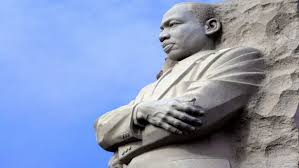
I had the good fortune of visiting the then new memorial dedicated to Martin Luther King on a beautiful summer evening several years ago. It was crowded, but deep thoughts were clearly moving behind reverent faces and faraway looks. It was my privilege to be there with my mother-in-law, an African-American woman who is King’s exact contemporary, and I only wished that her ninety-nine year old mother could have joined us as well.  I had seen pictures and read about the memorial, knew about the controversies that surrounded its creation, and wondered if it could possibly hope to represent the magnitude of what King gave to this country, all the while thinking that as a work of art it was hardly breaking any new ground aesthetically, and in fact it looked rather Stalinesque to me in the photos I had seen.
images

How good to be surprised. The quotes are strong and (sadly) as appropriate to our own time as four or five decades ago.  I knew there had been criticism by Maya Angelou, among others, of the expression on King’s face, but we studied it for a long time and what we saw was a man who didn’t like what he was seeing, gazing, as he is, at the conflicted slave-owner Thomas Jefferson across the Tidal Basin. Or perhaps it’s an expression of discomfort, knowing he was being called to do dangerous work that required his reluctant response, found in words of the prophet Isaiah…here am I, send me.

Arms crossed, expression stern, King seems poised to do something about the inequities around him. We slowly read each of the quotes carved into the monument’s stones and mourned the lack of such soaring rhetoric in our own time.

On the way out a park ranger heard our conversation and stopped to ask what we thought of the memorial, and we asked him in turn what his impressions were. He told us that when he had first seen the memorial, weeks before it opened, he wasn’t very impressed. As soon as it opened to the public he realized that the memorial had been missing something. People.  People walking and thinking and quietly conversing, teaching their children and asking their elders – that’s what made the memorial a success in his opinion.

From the mountain of despair, a stone of hope, so the memorial is called.  We the people, so begins the U.S. Constitution. The people, each of us one stone of hope. Each of us called to be a dreamer.

Peace,

* * * * *

This blog represents my attempt to put thoughts together on various things that seem to connect – in my mind anyway. More often than not new ideas first involve reaching back to what was and I can only hope that the prehistoric San cave painting at the top of this page inspires all kinds of connections between old and new.

Feel free to pass this message along to anyone who might be interested. You can simply subscribe (look for the “Subscribe” button at the top of the post) to get a reminder of new posts, or you can register with a user name and password in order to comment. If a community conversation comes out of this, all the better. We have so much to share and so much for which we can be grateful.

Light

Faith is the bird that feels the light when the dawn is still dark.
(Rabindrinath Tagore)

It’s not too soon to be grateful that days are already lengthening little by little. Even amid the cloudy days of winter we can sense light returning. The morning light appears a little earlier, the afternoon sun stays just a bit longer, and some primal instinct tells us the earth is slowly awakening. The liturgical calendar plants us in the season of Epiphany and gives us themes of light, beginning with the Magi following the light of a star, and ending two months from now with Jesus’ Transfiguration (celebrated on the last Sunday before Ash Wednesday), when the “Light of the world” gave his followers a glimpse of his divine nature, becoming a radiant, light-filled sign of God’s presence while conversing with Moses and Elijah on a mountain.

Light implies movement as well as brightness, moving through time with the speed of light, and when we are light-hearted and light on our feet it suggests buoyancy. Then, too, light is integral to perceptions of color, including defining people as light-skinned. I took some liberty, incidentally, this past Sunday with the beautiful motet of Peter Warlock, Bethlehem Down.  Its gorgeous text refers to Mary’s “white arms,” but we corrected that likely historical inaccuracy to sing about her “warm” arms instead.

But I digress! The Song of Simeon, a canticle taken from the Gospel of Luke which is sung or read as part of the evening office, takes us back to the light of sun and stars. These are the grateful words of an old man upon seeing the infant Jesus and understanding what he holds in his arms:

Lord, now lettest thou thy servant depart in peace according to thy word. For mine eyes have seen thy salvation, which thou hast prepared before the face of all people; To be a light to lighten the Gentiles and to be the glory of thy people Israel.

aert_de_gelder_-_het_loflied_van_simeon

Three ways to be illuminated by Simeon’s words:

Artistically, the ability to capture light, as seen in this 18th century depiction by Aert de Gelder of Simeon with Mary and Jesus, is often considered the mark of a great painter.

It is more difficult to capture light in sound.  Composers might find it in shimmering string sounds, or the clarity of straight-toned high voices, but often a text has to do some of the work.  The final line of Simeon’s prayer  – a light to lighten the Gentiles –  has inspired many, many composers to soar in musical arcs of light. In honor of this week’s celebration of Christmas by the Orthodox Church…Rachmaninoff’s setting of Simeon’s words in the Nunc Dimities from his Vespers:

And finally, Simeon’s story takes poetic flight in T. S. Eliot’s A Song for Simeon: “my life is light,” Eliot writes here.

We can find beauty in any artistic expression of Simeon’s cry, a light to lighten the Gentiles, but sometimes life is more shadow than light and it is those times when we can hold on to Tagore’s words above, believing that light is possible even before it appears.

Ultimately the greatest beauty is found in our own ability to embody light, to be radiant, buoyant expressions of love moving through this world.

Peace,

Sonya

* * * * *

This blog represents my attempt to put thoughts together on various things that seem to connect – in my mind anyway. More often than not new ideas first involve reaching back to what was and I can only hope that the prehistoric San cave painting at the top of this page inspires all kinds of connections between old and new.

Feel free to pass this message along to anyone who might be interested. You can simply subscribe (look for the “Subscribe” button at the top of the post) to get a reminder of new posts, or you can register with a user name and password in order to comment. If a community conversation comes out of this, all the better. We have so much to share and so much for which we can be grateful.


No Pressure

It’s difficult to convey sarcasm in writing without naming it directly, so let me be clear about the title – it’s meant to imply a bit of eye-rolling.  It is what we say when we know we’ve asked the impossible of someone…maybe something like, “you were born to save mankind.  No pressure.”

The choir at Church of the Epiphany is singing, among many other things, a setting of the Wexford Carol on Christmas Eve. It’s an old Irish carol that originated in County Wexford and the final stanza reads:

With thankful heart and joyful mind the shepherds went the babe to find, And as God’s angel had foretold they did our Saviour Christ behold. Within a manger he was laid and by his side the virgin maid attending on the Lord of Life, who came on earth to end all strife.

Who came on earth to end all strife?  No pressure.

I’ve written before about the Dorothy Parker poem A Prayer for a New Mother, which expresses a wish that Mary just enjoy her little baby, without any knowledge of what is to come for her son. Could she just appreciate the simple and wonderful things about him? His gentleness, his smile, his beautiful eyes? Maybe she had her own plans for him, ones that didn’t entail ending all strife.

My own son was born the night the first war in the Persian Gulf began. If you remember the build up through late 1990, it was a very tense time, and our country began a massive air offensive on the night of January 17, 1991 just as I was going into labor.  As it happens, I would be having my baby at a military hospital, so that night when we drove up to the gate and the guard was told why we were there, he exclaimed, “tonight?  you’re having a baby tonight!?”

Apparently it was an inconvenient time. I wonder if Mary felt something similar when she and Joseph trudged into Bethlehem looking for shelter. As I labored, the entire hospital staff was gathered around large television screens watching a war unfold. It clearly was an inconvenient time to have a baby. I know that we’re not supposed to make deals with God, but in those hours of labor bargaining with God seemed like a very good idea indeed. And this was my bargain – make this pain end and let me have a healthy baby, and I promise that he will be a peacemaker.

No pressure, my son.

As with our children, it probably isn’t a good idea to pressure God to be what we want. Make that a terrible idea actually. My father, a Hindu, reminded us regularly that people were happiest when they wanted what they already have. In the same way, we show our love more completely when we love people just as they are. And instead of expecting God to do what we want, we might do well to instead see God in all those things large and small that change the world for the better. Which is the only place we’ll find God anyway.

A peaceful Christmas wish for us all.

Sonya

* * * * *

This blog represents my attempt to put thoughts together on various things that seem to connect – in my mind anyway. More often than not new ideas first involve reaching back to what was and I can only hope that the prehistoric San cave painting at the top of this page inspires all kinds of connections between old and new.

Feel free to pass this message along to anyone who might be interested. You can simply subscribe (look for the “Subscribe” button at the top of the post) to get a reminder of new posts, or you can register with a user name and password in order to comment. If a community conversation comes out of this, all the better. We have so much to share and so much for which we can be grateful.
Veni Emmanuel

In the Christian church, the new year – the liturgical year – begins this coming Sunday with a four week journey known as Advent. It’s often described as a time of waiting, watching, and hoping, and a season when we might try to quiet our minds in the midst of the chaos around us, but living in a state of anticipation and also with a quiet mind seem to be at odds with each other. Somehow we have to accept that Advent is a season of duality. A time of joy and penance, beginnings and end times, the comfort of God’s word and the discomfort of the prophets’ messages, images of light and darkness.

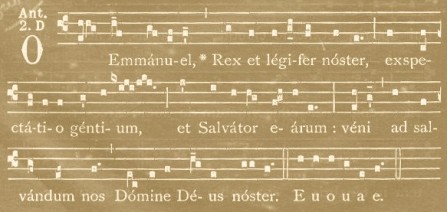
I love the hymns of Advent, and no hymn better captures the two sides of Advent than O come, o come Emmanuel, sometimes known by its Latin name, Veni emmanuel. Its text is built on the ancient words of the “O Antiphons” which were sung before and after the chanting of Mary’s Magnificat in the seven days preceding Christmas Eve (hence the dates you see before each verse). Mourning in lonely exile (vs 1), we’re asked in the refrain to “Rejoice!”

My soul proclaims the greatness of the Lord and my spirit rejoices in God my savior, the first line of the Magnificat, is Mary’s brave response to God’s plan for her to have a child, one who will be both human and divine.

oemmanuel

Each verse of Veni Emmanuel (#56 in The Hymnal 1982) begins with a salutation, in the form of a name for God, and then an invitation for each of these aspects of God to come into our lives. An invitation is meaningless, of course, unless the door has been left open, so don’t sing this beautiful hymn unless your heart is open to change!

O Sapienta (v. 2)  O come, wisdom, and show us a path towards knowledge

O Adonai (v. 3) O come, Lord of might, and with an outstretched arm, save us

O Radix Jesse (v. 4)  O come, branch of Jesse’s tree, and be a sign of God’s love

O Clavis David  (v. 5)  O come, Key of David, and open the gates of life and set us free

O Oriens (v. 6)   O come, Radiant Light, and shine on those who sit in darkness

O Rex gentium (v. 7)   O come, King of all people, and end our sad divisions

O Emmanuel  (vss 1 and 8)  O come, Emmanuel, and dwell among us

In the complexity of this life, may we discover truth somewhere in the middle of all the dichotomies of Advent. Anticipation and peacefulness. Questions and answers. Joy and penance. Comfort and discomfort. And in all of that, may it be a journey towards light and rebirth, a triumph of dreams and hopes over our knowledge of life’s dark places.

Veni Emmanuel,

Sonya

* * * * *

This blog represents my attempt to put thoughts together on various things that seem to connect – in my mind anyway. More often than not new ideas first involve reaching back to what was and I can only hope that the prehistoric San cave painting at the top of this page inspires all kinds of connections between old and new.

Feel free to pass this message along to anyone who might be interested. You can simply subscribe (look for the “Subscribe” button at the top of the post) to get a reminder of new posts, or you can register with a user name and password in order to comment. If a community conversation comes out of this, all the better. We have so much to share and so much for which we can be grateful.

Armistice

A century of human existence and memories since the end of the war to end all wars. Sigh…if only World War I could have reached that implausible goal. The eleventh hour of the eleventh day in the eleventh month in 1918 marked the armistice that was really only a temporary end to the fighting. As history showed, an actual treaty wasn’t signed for another seven months and unresolved anger smoldered for nearly twenty years more before erupting into another world war. A somber world does mark this centenary, however, and my mind went to an unlikely musical commemoration of World War I – Maurice Ravel’s Le Tombeau de Couperin.

This is an elegant set of six pieces which takes its cue from Baroque keyboard suites, with many of the movements based on archaic folk dances. It was written between 1914-1917, published in 1918 and premiered in 1919, with each movement dedicated to a friend of Ravel’s who had died in the war. Ravel himself served as a driver in support of the troops near Verdun and was eyewitness to war’s harrowing brutality, an experience which unsurprisingly left him ill and depressed.

But this is not music of war. It’s charming and dance-like. A suite of piano pieces, later orchestrated, based on the ideals of an earlier time, ideals of gentility and gracefulness. Ravel’s musical response to horror might seem incongruous, more escape than commemoration. Where is the anguish or anger heard in other composer’s works? Vaughan Williams captured such a sense of aching loss in his post-war music, others such as Elgar and Parry sought to inspire and console their broken countrymen.  Alban Berg’s opera Wozzeck, begun in 1914, reveals the absurdity and doom of a pointless war.

So how does Le Tombeau de Couperin, a composition inspired by music from two centuries earlier, speak to the pain of living through the destruction and death he was seeing all around him? This is music of color and even of joy. When asked about this seeming paradox, Ravel replied, “The dead are sad enough in their eternal silence.”

Everyone mourns in their own way, and grief takes many forms. Much of Ravel’s music could be considered somewhat emotionally detached. Perhaps he found solace in approaching grief from some distance, and there was so much to mourn. Deaths of young friends, destruction of the French countryside turned into battlefields, and what may have seemed at the time like the end of French culture and civility.  And so he wrote a tombeau for all of those things – for his friends as much as for the elegance and order that the music of Couperin represented. He would leave it to other composers to express their grief and loss in more graphic terms.

Ravel instead chose to write music of memory. Perhaps he had moved beyond the stages of denial and anger and depression to a place of acceptance. Perhaps he needed to counter inexplicable ugliness and cruelty with the light and beauty of ancient dances. Perhaps he knew that an armistice is, like everything, only temporary, and chose not to dwell in hopelessness.

Peace,
Sonya

* * * * *

This blog represents my attempt to put thoughts together on various things that seem to connect – in my mind anyway. More often than not new ideas first involve reaching back to what was and I can only hope that the prehistoric San cave painting at the top of this page inspires all kinds of connections between old and new.

Feel free to pass this message along to anyone who might be interested. You can simply subscribe (look for the “Subscribe” button at the top of the post) to get a reminder of new posts, or you can register with a user name and password in order to comment. If a community conversation comes out of this, all the better. We have so much to share and so much for which we can be grateful.


Ordinary Saints

All Saints Day 2018

The optimists among us would like to believe there is good in everyone, but let’s be honest – not everyone exhibits the kind of extraordinary holiness and virtue we associate with saints. Not everyone is fearless enough to stand up to those in power or walk among lepers or stand in solidarity with the oppressed.

After someone dies they are often recast in more saintly terms. I always wonder if people said or thought those same kind words that are spoken in eulogies while the person was alive. I know that my own father – a remarkable person in so many ways, but hardly a saint – acquired an aura of saintliness within the family after his death. I would give almost anything to be able to go back in time and express a greater appreciation of him while he was living, but his goodness was of the ordinary kind that isn’t seen without the perspective of time. It was a goodness that provided a safe and loving home, and stayed up late to help with math homework, and drove 500 miles to be with me a month before dying of lung cancer because I was going through a rough patch in my life.

IMG_0538

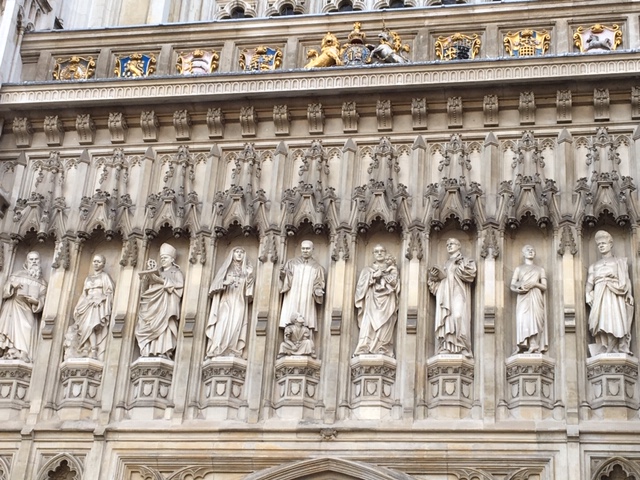
I could not have been more surprised this past summer when I saw what – or rather, who – stood just above the West Front doors of Westminster Abbey. There, modern day saints are honored in arguably one of the most prominent places in the world. In the very center – Martin Luther King and Oscar Romero (both depicted with children, interestingly). Today, All Saints Day, is their day. A feast day for those exceptional people who have walked among us, whose lives and works changed the world. These were people who helped us see more clearly that God dwells among us and whose faith led them into danger, defiance, and sacrifice.

All Souls Day is tomorrow, November 2, and that is when we have the special intention of remembering those we loved, those ordinary people who happened to be extraordinary to us. No statues, but a liturgical acknowledgement that everyone is important to God and will be welcomed into everlasting life.  All souls, saint or not.

Do not stand at my grave and weep
I am not there; I do not sleep.
I am a thousand winds that blow,
I am the diamond glints on snow,
I am the sun on ripened grain,
I am the gentle autumn rain.
When you awaken in the morning’s hush,
I am the swift uplifting rush
Of quiet birds in circled flight.
I am the soft stars that shine at night.
Do not stand at my grave and cry,
I am not there; I did not die.  (Mary Elizabeth Frye – 1932)

With a Celtic sensibility, these oft-quoted words help us find comfort in ordinary things as we mourn those we cannot see, but who we still long to feel in our lives. Real saints change the world. Ordinary saints change one heart at a time. We need more of both.

Peace,
Sonya

* * * * *

This blog represents my attempt to put thoughts together on various things that seem to connect – in my mind anyway. More often than not new ideas first involve reaching back to what was and I can only hope that the prehistoric San cave painting at the top of this page inspires all kinds of connections between old and new.

Feel free to pass this message along to anyone who might be interested. You can simply subscribe (look for the “Subscribe” button at the top of the post) to get a reminder of new posts, or you can register with a user name and password in order to comment. If a community conversation comes out of this, all the better. We have so much to share and so much for which we can be grateful.


The Still Point

Time present and time past
Are both perhaps present in time future
And time future contained in time past.

What are memories made from? I know there are scientific answers to that question, but I’m more interested in the metaphysical explanation. We know that memory is malleable, that we can’t count on our memories of conversations and events being completely accurate. Or at least, we should know that. I believe we do remember feelings – our feelings of fear or happiness, safety or sorrow. More than sight, senses of smell and hearing seem to create lasting memories that often relate to our feelings, rather than to specific moments in our lives. Our house was affected by a tornado several years ago, and it wasn’t until weeks later when I sat on an airplane and heard the jet engines roar to life that I suffered a few moments of PTSD.  I don’t recall hearing anything except breaking glass in my panic at the time, until I heard a similar sound which caused that panic to return.

At the still point of the turning world. Neither flesh nor fleshless;
Neither from nor towards; at the still point, there the dance is,
But neither arrest nor movement. And do not call it fixity,
Where past and future are gathered. Neither movement from nor towards,
Neither ascent nor decline. Except for the point, the still point,
There would be no dance, and there is only the dance.

Wrestling with T.S. Eliot’s Burnt Norton seems like an autumnal event to me. I don’t pretend to have any depth of understanding of these poems in his Four Quartets, but the words evoke familiar feelings that I yearn to understand, and cause questions to arise which don’t have answers. There is so much truth in Eliot’s belief that poetry communicates before it is understood. News and life have lately conspired to make me think about memories and nostalgia and all the ways that our minds hold on – or let go – of life’s experiences.  Is Eliots’ “still point” the moment when the present meets our former self in a memory? Do the future and past exist within the present?

Go, said the bird, for the leaves were full of children,
Hidden excitedly, containing laughter.
Go, go, go, said the bird: human kind
Cannot bear very much reality.
Time past and time future
What might have been and what has been
Point to one end, which is always present.

An important figure in my childhood memories died recently. He lived on a farm where my friend and I spent our summers, and she and I will return to the scenes of those youthful summers which bound us so closely together for a memorial service. Memories of those idyllic summers from many decades ago are back in force right now. Laying in the grass under the shade of a tree-lined horse pasture, propped on elbows in hunt of four-leaved clover.  Picnics near the opening to a badger’s den that we watched for years with hope of seeing a nose poke out, wind moving through the pine trees, games of croquet and badminton that became boring or competitive depending on the day. It was a childhood of summers spent reading on the screened porch and picking gigantic zucchinis that seemed to grow overnight. Reclaiming those memories means reclaiming those feelings of freedom and wonder and a thousand life lessons, and all of that makes me feel like I am moving through Eliot’s coexistence of time past and present and future.

In another part of my life, my mother is shedding new memories more quickly and clinging to old memories more ferociously. I’ve entered her world of time past and present in ways that I hope will keep us close for as long as possible. I’ve also begun teaching a piano student who is openly and bravely facing memory issues. Music is this person’s connection between past and present. In Oliver Sack’s book Musicophilia he writes in the final chapter, titled “Music and Identity,” about the ways that music experienced by dementia patients draws on the deepest parts of their memories, but also grounds them in the present, creating shared experiences of listening and singing with others around them.

Words move, music moves
Only in time; but that which is only living
Can only die. Words, after speech, reach
Into the silence.

Peace,
Sonya

* * * * *

This blog represents my attempt to put thoughts together on various things that seem to connect – in my mind anyway. More often than not new ideas first involve reaching back to what was, and I can only hope that the prehistoric San cave painting at the top of this page inspires all kinds of connections between old and new.

Feel free to pass this message along to anyone who might be interested. You can simply subscribe (look for the “Subscribe” button at the top of the post) to get a reminder of new posts, or you can register with a user name and password in order to comment. If a community conversation comes out of this, all the better. We have so much to share and so much for which we can be grateful.


Meanwhile

Interim: provisionaltemporary, pro tem, stopgap, short-term, fill-in, caretaker, acting, transitional, makeshift, improvised, impromptu

Origin: 16th century (denoting a temporary or provisional arrangement, originally for the adjustment of religious differences between the German Protestants and the Roman Catholic Church): from Latin, ‘meanwhile.’

Yo Yo Ma, the celebrated cellist and humanitarian, is blessed with much more than musical talent. He has gifts of curiosity and personal warmth that bring people together in all sorts of wonderful ways. “Music,” he said in a recent NPR interview, “actually was invented, as all of culture was invented — by us — to help all of us figure out who we are.”  He has recorded the six Bach cello suites for the third time in his long career, and asks himself what has changed in the music for him since he last recorded them nearly 20 years ago. I hope you will take a few minutes to hear this brief interview about his latest project.

The music of Bach might be 300 years old, but it doesn’t stay the same. The notes are a foundation of sorts, but the space between the notes is ever changing. For an artist like Yo Yo Ma it has provided a lifetime of both stability and variety. A foundation, after all, is as much an underpinning as it is a point of departure.

Getting back to where I started, it is so interesting that the word “interim,” was born of religious strife. Though used in lots of ways now, it still describes a particular kind of religious leadership, which is often enough necessitated by trouble in the institution. Interims are people in the church who might be described with any of those definitions at the top – temporary, fill-in, caretaker, transitional – but they should be much more. Shedders of light, sea captains through rocky waters, absorbers of anxiety.

A kind of limbo is implied for those places that need interim leadership. This is usually a chance to re-examine and re-order what was, attempt to give the accumulated dirty laundry a good airing, and get ready to move into the future. Ideally anyway.

I was deeply hurt a few years ago by many people in positions of leadership at a religious institution. “Stand in line,” you say? You too were betrayed by people you had thought cared about you? Who were supposed to value things like justice and truth and kindness? You’ve also had the rug pulled out by people and places that you trusted? Okay, I’ll go to the back of that very long line.

But as I deal with that hurt – and honor its pain as part of what makes me whole – I am reminded regularly that change is the only constant. Everything changes  – our relationships, our families, our bodies, our jobs, our homes. And those changes create in-between times. Is life just one big interim period then? Are we always in some kind of limbo? And if so few things stay as they are, well, then where in the shifting sands can we build a foundation to stand on?

In serving 6 different churches in musical interim capacities of one sort or another during the past two and half years, and amid all the challenges of jumping into new situations and dealing with so many new people and ways of doing things, I try to help people through those periods of shifting sands, broken relationships, and confusing changes, and I think sometimes that I have found a foundation for myself by being a foundation for others in these places.

So much of what’s wrong in the world is summed up by the inexplicable human need to feel superior. That drive is unmasked in different ways, all of them damaging to our souls  – like racism or classism or consumerism. For whole countries and cultures it’s too often expressed by insularity, rapaciousness, and violence.

We often do, in fact, have more resources than many people around us. For me, they are resources of family, friends, time, enough money, a capacity to care and to listen, a home, freedom. These aren’t things that make me superior to anyone, but they give me strength to be the foundation others might need to get through their in-between times of confusion or hurt or scarcity.

Like the space between musical notes, we have in-between times in our lives that are also important. Interim periods require us to negotiate the movements between sorrow and joy, strength and weakness, moderation and passion, constancy and change. That can be disorienting and disturbing, but ultimately being able to do so, I think, is what makes us strong. Meanwhile, for the times when we need some help getting through transitions…well, among our many resources, we always have Bach.   (Suite No. 5).  According to Yo Yo Ma, music will help us figure out who we are, and just maybe who we are supposed to be in this world.

Peace,
Sonya

* * * * *

This blog represents my attempt to put thoughts together on various things that seem to connect – in my mind anyway. More often than not new ideas first involve reaching back to what was, and I can only hope that the prehistoric San cave painting at the top of this page inspires all kinds of connections between old and new.

Feel free to pass this message along to anyone who might be interested. You can simply subscribe (look for the “Subscribe” button at the top of the post) to get a reminder of new posts, or you can register with a user name and password in order to comment. If a community conversation comes out of this, all the better. We have so much to share and so much for which we can be grateful.


A Rose By Any Other Name

In the past couple of years I have taken on a few adult piano students, and found that I enjoy teaching piano now so much more than my younger self ever did. One of my students has been working on the Debussy prelude Voiles. It’s a beautiful piece, perfectly capturing Debussy’s ethereal language of whole-tone scales and glissando-like figures.  I had always known this piece to have an English title of “Sails,” and was surprised to learn that is only one of many meanings of the French “voiles.” It can also mean “veils,” or “shroud” or “fog.” Debussy was purposely vague about the title, but it changes the music completely.  Are we playing music that evokes a sun-filled day on the lake or a foggy world seen from behind a veil? You decide:

Voiles – take one                Voiles – take two

Or maybe it’s a foggy day on the lake!  Words matter. How we interpret something changes everything, as we well know from the proverb of the glass half-empty or half-full. Sorry, Mr. Shakespeare, but I respectfully disagree.  A rose that’s called a latrine-blossom probably won’t smell as sweet.

This Sunday at Church of the Epiphany we’ll hear one of the newer additions to the lectionary in the Episcopal Church, the canticle A Song of Wisdom. Christians have inherited a patriarchal theology, but the church does try sometimes to widen the scope of our understanding, and we find that even small words, like pronouns, matter.

Wisdom freed from a nation of oppressors a holy people and a blameless race.  She entered the soul of a servant of the Lord, withstood dread rulers and wonders and signs…She was their shelter by day and a blaze of stars by night…

Wisdom

It was over a year ago now that I finished writing about Bach’s Goldberg Variations, tying each of the 30 variations to a personal quality that I found worthy of cultivating. In the final movement, the opening Aria returns, now seemingly imbued with the wisdom gained by a lifetime of experiences. Wisdom is so very different from being smart or academically gifted. It’s slow, thoughtful, and simple. Wisdom is learning to not respond immediately, temporarily walking away from a difficult moment, knowing that the answer will come. It’s being quiet and listening.

My own name is a variation of Sophia, Greek for wisdom. I don’t claim to have an abundance of it, but I so admire it in others. For me, wisdom has been gained when I’ve tried harder to see both sides of an issue, or even when I choose to take a walk instead of answering emails. When I let wisdom come to me instead of trying too hard to find it.

An interesting side-note about Voiles – in French, the masculine “le voile” means “veil” and the feminine “la voile” means “sail.” Debussy left out the defining article in his title – a tiny, but clarifying word. Creatures are largely divided into male and female, but recently society has been allowed to admit that there are some people in between that clear division. Time and the urban dictionary will find the right words for us to express this in-betweeness in our everyday language. Meanwhile, we can push gently (or not) against cultural taboos and boxed-in thoughts. Remembering that words really do matter feels to me like a step towards wisdom.

Peace,
Sonya

* * * * *

This blog represents my attempt to put thoughts together on various things that seem to connect – in my mind anyway. More often than not new ideas first involve reaching back to what was, and I can only hope that the prehistoric San cave painting at the top of this page inspires all kinds of connections between old and new.

Feel free to pass this message along to anyone who might be interested. You can simply subscribe (look for the “Subscribe” button at the top of the post) to get a reminder of new posts, or you can register with a user name and password in order to comment. If a community conversation comes out of this, all the better. We have so much to share and so much for which we can be grateful.


Chaos

This is not a commentary on current times, political or personal, but rather an examination yet again of finding meaning in unusual places. Of finding beauty in chaos.

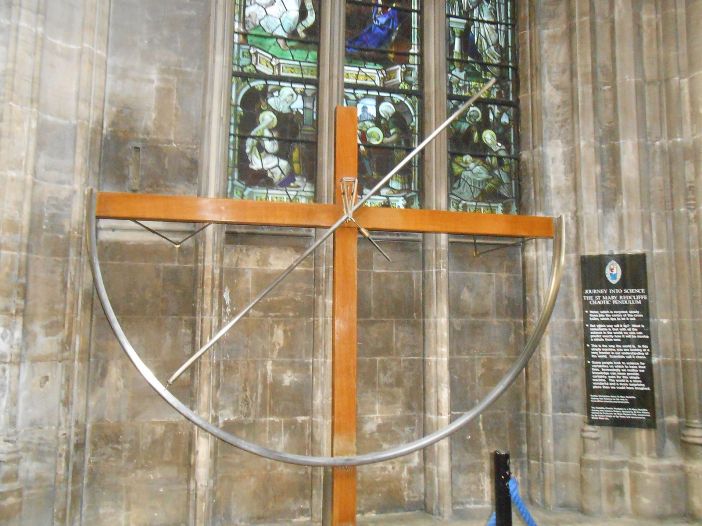
It began with”the fairest, goodliest, and most famous parish church in England,” as the church of St. Mary Redcliffe was described by Queen Elizabeth I.  It’s a Gothic masterpiece, found on a busy street in a gritty part of a city that is slowly finding its way out of a slave-trade inheritance to become a cultural incubator of the arts in the 21st century (including a very popular Wallace and Gromit tour). I was there for a few days last month and one of the very few photos that I took was of the accompanying sign to this water-powered pendulum found in St. Mary’s Redcliffe.  The sign reads:St_Mary_Redcliffe_Chaotic_Pendulum,_Bristol

Journey into Science: The St. Mary Redcliffe Chaotic Pendulum.  It goes on to describe the process of water moving through the cross beams, unpredictably tipping one way or another, and likening that unpredictability to the ways of the world.

In this simple machine you are looking at a new frontier in our understanding of the world.  Scientists call it chaos.  Some people look to science for certainties on which to base their lives.  Increasingly we realize our knowledge can never provide certainty, even for this simple machine.  The world is a more wonderful and a more surprising place than we could have imagined.

Chaos suggests a lack of rules and form, but maybe it’s really just describing an unseen structure or set of rules. Perhaps the water’s flow through the pendulum responds to rules that are beyond human imagination, or forms that haven’t been described yet. I have to think that much of our world, including our music, would seem incredibly chaotic to our ancestors, should they be able to visit us in 2018. Yet we are surrounded by patterns, and our music is based on recognizable progressions. Could it be that there is meaning in those things which we aren’t evolved enough yet to understand?

I’ve been spending some time with the piano music of Philip Glass this summer. To the resistant listener, it probably sounds random, with its repetitive patterns and unpredictable shifts. I am not an expert on his music, nor have I spent hours analyzing it, but I’ve found playing it to be a wonderful way to warm up my fingers and center my mind. The difficulties of his music are not the usual ones – playing the notes isn’t hard, but staying focused and negotiating the subtle moves in the music is.

Things which seem completely random and unrelated can still draw someone into an artistic experience. Perhaps because there are patterns that lie below the surface of seeing which speak to a hidden part of our brain. The works of artist Jackson Pollock, for example, have been analyzed using fractal analysis. Could this same process be applied to the music of Glass ? Does the human desire for patterns and repetition draw us even toward those things which might seem chaotic at first glance?

Image property of the Albright-Knox Art Gallery, Buffalo, NY.

I begin working this week as the Interim Music Director at Church of the Epiphany in Washington D.C., and will be there for the next eight months. Church can, at its best, offer an antidote to life’s chaotic moments, don’t you think? I wonder if I’ll learn that the world is indeed a more wonderful and more surprising place than I could have imagined.

Peace,
Sonya

* * * * *

This blog represents my attempt to put thoughts together on various things that seem to connect – in my mind anyway. More often than not new ideas first involve reaching back to what was and I can only hope that the prehistoric San cave painting at the top of this page inspires all kinds of connections between old and new.

Feel free to pass this message along to anyone who might be interested. You can simply subscribe (look for the “Subscribe” button at the top of the post) to get a reminder of new posts, or you can register with a user name and password in order to comment. If a community conversation comes out of this, all the better. We have so much to share and so much for which we can be grateful.