Commuting in America

One of my favorite parts of my week is the walk I take every Wednesday from the church where I am working at 13th and G Street to the church where I have a  midday rehearsal at 20th and G Street. That would seem like a pretty straight shot along seven blocks of a single street, but nothing is quite so simple when you travel around the city of Washington D.C.

My route is bisected diagonally by Pennsylvania Avenue, and that takes me past the house at 1600 every week. Being a veteran Washingtonian of more than 30 years now, I am too cool, of course, to gawk at The White House, but the house itself is the least interesting thing along my commute. That long stretch of Pennsylvania Avenue, with Lafayette Square on one side, and a wide swath of pavement that was blocked off from cars more than a decade ago, beckons people from every state and continent. Musicians playing everything from rock guitar to smooth saxophone to mountain tunes on the harmonica.  Camera-wielding tourists, families, and people in wheelchairs. Evangelists for their own brand of God’s good news, and protestors of causes I didn’t even know existed. People who have created memorials for those lost at war or for lives wasted by gun violence. Men in well-pressed suits zipping by on scooters, briefcases in hand, weaving around strollers and the very obvious security guards, who stand seemingly at ease, but clearly attuned to everything and everyone around them.

Of all that I’ve seen on my Wednesday pedestrian commutes, the best so far has been a group of men in robes and large white hats. From a distance I feared a gathering of the KKK, but getting closer I saw that these were dark-skinned men who held signs proclaiming themselves to be Moors. It wasn’t clear what they were protesting, but if their goal was to let the world know that the Moors still live, they succeeded with me. Did you know there are still people who identify as Moors today?

There are always lessons to be learned, and I love my few minutes every week of seeing the world gathered, sometimes to gawk and sometimes to proclaim. We can’t know if the residents of The White House are observing anything that happens outside their windows, but I find hope in what I see – community, curiosity, diversity…and street musicians! As we look forward to Thanksgiving next week I am grateful to witness America on that stretch of Pennsylvania Avenue. It’s colorful and messy and so very beautiful in its openness to all sorts and conditions.

  *   *   *   *   *

Ralph Waldo Emerson and T.S. Eliot, among many others, have quotes attributed to them about the journey mattering more than the destination. They remind us that transient moments have value and enrich our lives. That the journey itself can bring happiness. I certainly feel that on Wednesday afternoons.

Reaching a destination suggests an ending, but as every musician knows, the journey is all we have. We will never reach a musical destination because we know that something could always be better – a phrase more beautifully shaped, an emotion more clearly expressed, or a technical passage more perfectly executed. I think that’s probably true for every part of our lives. We’re all works in progress, so why not appreciate the commute as a welcome part of life.

Peace,
Sonya

* * * * *

This blog represents my attempt to put thoughts together on various things that seem to connect – in my mind anyway. More often than not new ideas first involve reaching back to what was and I can only hope that the prehistoric San cave painting at the top of this page inspires all kinds of connections between old and new.

Feel free to pass this message along to anyone who might be interested. You can simply subscribe (look for the “Subscribe” button at the top of the post) to get a reminder of new posts, or you can register with a user name and password in order to comment. If a community conversation comes out of this, all the better. We have so much to share and so much for which we can be grateful.


Armistice

A century of human existence and memories since the end of the war to end all wars. Sigh…if only World War I could have reached that implausible goal. The eleventh hour of the eleventh day in the eleventh month in 1918 marked the armistice that was really only a temporary end to the fighting. As history showed, an actual treaty wasn’t signed for another seven months and unresolved anger smoldered for nearly twenty years more before erupting into another world war. A somber world does mark this centenary, however, and my mind went to an unlikely musical commemoration of World War I – Maurice Ravel’s Le Tombeau de Couperin.

This is an elegant set of six pieces which takes its cue from Baroque keyboard suites, with many of the movements based on archaic folk dances. It was written between 1914-1917, published in 1918 and premiered in 1919, with each movement dedicated to a friend of Ravel’s who had died in the war. Ravel himself served as a driver in support of the troops near Verdun and was eyewitness to war’s harrowing brutality, an experience which unsurprisingly left him ill and depressed.

But this is not music of war. It’s charming and dance-like. A suite of piano pieces, later orchestrated, based on the ideals of an earlier time, ideals of gentility and gracefulness. Ravel’s musical response to horror might seem incongruous, more escape than commemoration. Where is the anguish or anger heard in other composer’s works? Vaughan Williams captured such a sense of aching loss in his post-war music, others such as Elgar and Parry sought to inspire and console their broken countrymen.  Alban Berg’s opera Wozzeck, begun in 1914, reveals the absurdity and doom of a pointless war.

So how does Le Tombeau de Couperin, a composition inspired by music from two centuries earlier, speak to the pain of living through the destruction and death he was seeing all around him? This is music of color and even of joy. When asked about this seeming paradox, Ravel replied, “The dead are sad enough in their eternal silence.”

Everyone mourns in their own way, and grief takes many forms. Much of Ravel’s music could be considered somewhat emotionally detached. Perhaps he found solace in approaching grief from some distance, and there was so much to mourn. Deaths of young friends, destruction of the French countryside turned into battlefields, and what may have seemed at the time like the end of French culture and civility.  And so he wrote a tombeau for all of those things – for his friends as much as for the elegance and order that the music of Couperin represented. He would leave it to other composers to express their grief and loss in more graphic terms.

Ravel instead chose to write music of memory. Perhaps he had moved beyond the stages of denial and anger and depression to a place of acceptance. Perhaps he needed to counter inexplicable ugliness and cruelty with the light and beauty of ancient dances. Perhaps he knew that an armistice is, like everything, only temporary, and chose not to dwell in hopelessness.

Peace,
Sonya

* * * * *

This blog represents my attempt to put thoughts together on various things that seem to connect – in my mind anyway. More often than not new ideas first involve reaching back to what was and I can only hope that the prehistoric San cave painting at the top of this page inspires all kinds of connections between old and new.

Feel free to pass this message along to anyone who might be interested. You can simply subscribe (look for the “Subscribe” button at the top of the post) to get a reminder of new posts, or you can register with a user name and password in order to comment. If a community conversation comes out of this, all the better. We have so much to share and so much for which we can be grateful.


Ordinary Saints

All Saints Day 2018

The optimists among us would like to believe there is good in everyone, but let’s be honest – not everyone exhibits the kind of extraordinary holiness and virtue we associate with saints. Not everyone is fearless enough to stand up to those in power or walk among lepers or stand in solidarity with the oppressed.

After someone dies they are often recast in more saintly terms. I always wonder if people said or thought those same kind words that are spoken in eulogies while the person was alive. I know that my own father – a remarkable person in so many ways, but hardly a saint – acquired an aura of saintliness within the family after his death. I would give almost anything to be able to go back in time and express a greater appreciation of him while he was living, but his goodness was of the ordinary kind that isn’t seen without the perspective of time. It was a goodness that provided a safe and loving home, and stayed up late to help with math homework, and drove 500 miles to be with me a month before dying of lung cancer because I was going through a rough patch in my life.

IMG_0538

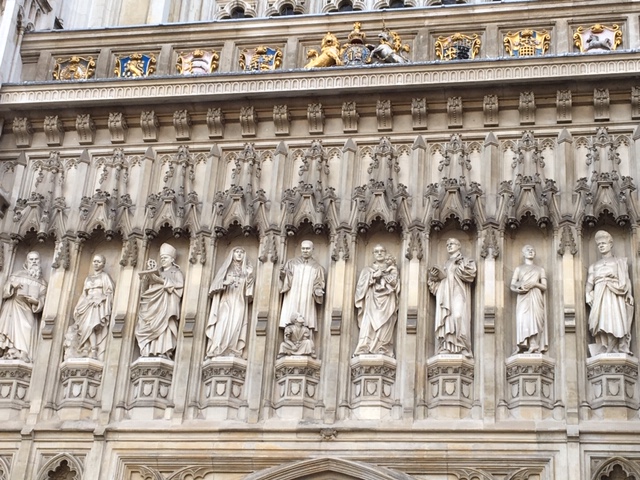
I could not have been more surprised this past summer when I saw what – or rather, who – stood just above the West Front doors of Westminster Abbey. There, modern day saints are honored in arguably one of the most prominent places in the world. In the very center – Martin Luther King and Oscar Romero (both depicted with children, interestingly). Today, All Saints Day, is their day. A feast day for those exceptional people who have walked among us, whose lives and works changed the world. These were people who helped us see more clearly that God dwells among us and whose faith led them into danger, defiance, and sacrifice.

All Souls Day is tomorrow, November 2, and that is when we have the special intention of remembering those we loved, those ordinary people who happened to be extraordinary to us. No statues, but a liturgical acknowledgement that everyone is important to God and will be welcomed into everlasting life.  All souls, saint or not.

Do not stand at my grave and weep
I am not there; I do not sleep.
I am a thousand winds that blow,
I am the diamond glints on snow,
I am the sun on ripened grain,
I am the gentle autumn rain.
When you awaken in the morning’s hush,
I am the swift uplifting rush
Of quiet birds in circled flight.
I am the soft stars that shine at night.
Do not stand at my grave and cry,
I am not there; I did not die.  (Mary Elizabeth Frye – 1932)

With a Celtic sensibility, these oft-quoted words help us find comfort in ordinary things as we mourn those we cannot see, but who we still long to feel in our lives. Real saints change the world. Ordinary saints change one heart at a time. We need more of both.

Peace,
Sonya

* * * * *

This blog represents my attempt to put thoughts together on various things that seem to connect – in my mind anyway. More often than not new ideas first involve reaching back to what was and I can only hope that the prehistoric San cave painting at the top of this page inspires all kinds of connections between old and new.

Feel free to pass this message along to anyone who might be interested. You can simply subscribe (look for the “Subscribe” button at the top of the post) to get a reminder of new posts, or you can register with a user name and password in order to comment. If a community conversation comes out of this, all the better. We have so much to share and so much for which we can be grateful.


Laugh Out Loud

Some good reasons to laugh – laughter raises our heart rates, increases blood flow and lowers stress, thereby boosting our immune system, lowering blood sugar levels, and yes, even burning calories, though not enough to justify extra chocolate, sadly. And those are just some physical benefits.  What is more psychologically healing than bonding with others around something humorous?

Laughter Clubs, a form of yoga, began developing in the 1990’s and is now a movement with over 8,000 groups of people gathering around the world, usually in the morning in a park, to simply laugh as a form of healing. I haven’t been to one but maybe I’ll start one in my back yard! Apparently the human body cannot differentiate between unfeigned, spontaneous laughter and forced laughter. Whenever I pretend to laugh it always seems to turn into real laughter anyway. Haven’t we all experienced the contagion of uncontrolled laughter that sometimes catches us at the most inopportune moments?  I certainly hope you have!

It seems like the more we’re digitally connected to the rest of the world, the less connected we actually are to our neighbors and family. Could laughter be a common ground that leads to more conversation with those around us? Here are some digitally delivered ideas to get you started.

Funny cat video, with a classical twist

You can’t listen to this notated laughter without laughing. I’m taking bets…

Not-So-Serious-Music

I really hope you click on the links above, and start laughing so loudly that someone hears you and joins you in laughter without even knowing why. Today, October 18, is the feast day for Saint Luke, Evangelist and patron saint of healing on the liturgical calendar. Though we don’t have a lot of control over many things that affect our lives, finding more times to laugh is a wonderful gift we can give ourselves, and one that beckons those around us to an irresistible adventure towards healing.

Hahahahahaha,

Sonya

If you saw my note last week inviting you to a house concert, please know that we have had to postpone the concert.  My musical partner has had a health emergency in her family.  Stay tuned for a new date.

* * * * *

This blog represents my attempt to put thoughts together on various things that seem to connect – in my mind anyway. More often than not new ideas first involve reaching back to what was, and I can only hope that the prehistoric San cave painting at the top of this page inspires all kinds of connections between old and new.

Feel free to pass this message along to anyone who might be interested. You can simply subscribe (look for the “Subscribe” button at the top of the post) to get a reminder of new posts, or you can register with a user name and password in order to comment. If a community conversation comes out of this, all the better. We have so much to share and so much for which we can be grateful.


Dead Leaves

Feuilles mortes (Dead Leaves) – Claude Debussy

The short work linked above, from Debussy’s second volume of preludes, has a decidedly straightforward title. For the composer, at the height of his career, but having learned recently that he had cancer, perhaps the desolation he expressed in this music required such a stark title. Though the music can seem blurry, Debussy was a master of clarity in capturing the essence of a feeling or a moment in sound, in this case the leaves of autumn, fallen and desiccated. Harmonically and rhythmically vague, as his music often is, it is music that seems filled with mournful sighs.

Why do we sigh? Whether we do so from frustration or from sadness, there’s one theory that suggests that our sighs serve as a re-set button. In all the ways that breath is life, our sighs overcome the shallow breathing we sometimes fall into and re-energizes our lungs. Maybe it’s a pointed “snap out of it” message from our brain. We can’t really know what was going on in Debussy’s own brain as he composed, but I’m grateful for the “snap out of it” messages that keep me from settling too comfortably into melancholy.

Feuilles mortes had another incarnation that many of you will recognize –

Fueilles mortes-Yves Montand

The translation of “Dead Leaves” sounds somewhat more alluring in French – Feuilles mortes. But then, as I learned this past summer while traveling in France, even the voice of the GPS sounds more alluring when he (there was no way this GPS voice was an “it”, nor a “she”) gave directions.

Les feuilles mortes se ramassent à la pelle, les souvenirs et les regrets aussi.                   Fallen leaves can be picked up by the shovelful, so can memories and regrets.

The American version softens death into merely falling, and changes the title from Dead Leaves to Autumn Leaves, but we often retreat into the prettier words of euphemism in order to save ourselves from confronting the hardest truths.

Of course, as with the lefts and rights of my friend’s French navigation system, allure is part of anything sung by Yves Montand.  He sings here a tender song of nostalgic longing, but it’s impossible to ignore the fact that this was a song written in France in 1945. There is no euphemism for all that is lost in wartime.

Nor for the loss of talent taken too soon:  Eva Cassidy singing Autumn Leaves

Debussy’s dead leaves are disorienting and bleak. Cassidy’s autumn leaves are heartbreaking. I gave myself permission to cry and to live in melancholy for just a bit as I listened, and so should you before you sigh and reset for whatever comes next.

Peace,
Sonya

if you’ve read down this far, you might be interested in a concert I’ll be doing on October 21 – Debussy’s Feuilles mortes is included – let me know if you’d like to attend.  Four Seasons of Caring – a house concert

* * * * *

This blog represents my attempt to put thoughts together on various things that seem to connect – in my mind anyway. More often than not new ideas first involve reaching back to what was, and I can only hope that the prehistoric San cave painting at the top of this page inspires all kinds of connections between old and new.

Feel free to pass this message along to anyone who might be interested. You can simply subscribe (look for the “Subscribe” button at the top of the post) to get a reminder of new posts, or you can register with a user name and password in order to comment. If a community conversation comes out of this, all the better. We have so much to share and so much for which we can be grateful.


The Still Point

Time present and time past
Are both perhaps present in time future
And time future contained in time past.

What are memories made from? I know there are scientific answers to that question, but I’m more interested in the metaphysical explanation. We know that memory is malleable, that we can’t count on our memories of conversations and events being completely accurate. Or at least, we should know that. I believe we do remember feelings – our feelings of fear or happiness, safety or sorrow. More than sight, senses of smell and hearing seem to create lasting memories that often relate to our feelings, rather than to specific moments in our lives. Our house was affected by a tornado several years ago, and it wasn’t until weeks later when I sat on an airplane and heard the jet engines roar to life that I suffered a few moments of PTSD.  I don’t recall hearing anything except breaking glass in my panic at the time, until I heard a similar sound which caused that panic to return.

At the still point of the turning world. Neither flesh nor fleshless;
Neither from nor towards; at the still point, there the dance is,
But neither arrest nor movement. And do not call it fixity,
Where past and future are gathered. Neither movement from nor towards,
Neither ascent nor decline. Except for the point, the still point,
There would be no dance, and there is only the dance.

Wrestling with T.S. Eliot’s Burnt Norton seems like an autumnal event to me. I don’t pretend to have any depth of understanding of these poems in his Four Quartets, but the words evoke familiar feelings that I yearn to understand, and cause questions to arise which don’t have answers. There is so much truth in Eliot’s belief that poetry communicates before it is understood. News and life have lately conspired to make me think about memories and nostalgia and all the ways that our minds hold on – or let go – of life’s experiences.  Is Eliots’ “still point” the moment when the present meets our former self in a memory? Do the future and past exist within the present?

Go, said the bird, for the leaves were full of children,
Hidden excitedly, containing laughter.
Go, go, go, said the bird: human kind
Cannot bear very much reality.
Time past and time future
What might have been and what has been
Point to one end, which is always present.

An important figure in my childhood memories died recently. He lived on a farm where my friend and I spent our summers, and she and I will return to the scenes of those youthful summers which bound us so closely together for a memorial service. Memories of those idyllic summers from many decades ago are back in force right now. Laying in the grass under the shade of a tree-lined horse pasture, propped on elbows in hunt of four-leaved clover.  Picnics near the opening to a badger’s den that we watched for years with hope of seeing a nose poke out, wind moving through the pine trees, games of croquet and badminton that became boring or competitive depending on the day. It was a childhood of summers spent reading on the screened porch and picking gigantic zucchinis that seemed to grow overnight. Reclaiming those memories means reclaiming those feelings of freedom and wonder and a thousand life lessons, and all of that makes me feel like I am moving through Eliot’s coexistence of time past and present and future.

In another part of my life, my mother is shedding new memories more quickly and clinging to old memories more ferociously. I’ve entered her world of time past and present in ways that I hope will keep us close for as long as possible. I’ve also begun teaching a piano student who is openly and bravely facing memory issues. Music is this person’s connection between past and present. In Oliver Sack’s book Musicophilia he writes in the final chapter, titled “Music and Identity,” about the ways that music experienced by dementia patients draws on the deepest parts of their memories, but also grounds them in the present, creating shared experiences of listening and singing with others around them.

Words move, music moves
Only in time; but that which is only living
Can only die. Words, after speech, reach
Into the silence.

Peace,
Sonya

* * * * *

This blog represents my attempt to put thoughts together on various things that seem to connect – in my mind anyway. More often than not new ideas first involve reaching back to what was, and I can only hope that the prehistoric San cave painting at the top of this page inspires all kinds of connections between old and new.

Feel free to pass this message along to anyone who might be interested. You can simply subscribe (look for the “Subscribe” button at the top of the post) to get a reminder of new posts, or you can register with a user name and password in order to comment. If a community conversation comes out of this, all the better. We have so much to share and so much for which we can be grateful.


Meanwhile

Interim: provisionaltemporary, pro tem, stopgap, short-term, fill-in, caretaker, acting, transitional, makeshift, improvised, impromptu

Origin: 16th century (denoting a temporary or provisional arrangement, originally for the adjustment of religious differences between the German Protestants and the Roman Catholic Church): from Latin, ‘meanwhile.’

Yo Yo Ma, the celebrated cellist and humanitarian, is blessed with much more than musical talent. He has gifts of curiosity and personal warmth that bring people together in all sorts of wonderful ways. “Music,” he said in a recent NPR interview, “actually was invented, as all of culture was invented — by us — to help all of us figure out who we are.”  He has recorded the six Bach cello suites for the third time in his long career, and asks himself what has changed in the music for him since he last recorded them nearly 20 years ago. I hope you will take a few minutes to hear this brief interview about his latest project.

The music of Bach might be 300 years old, but it doesn’t stay the same. The notes are a foundation of sorts, but the space between the notes is ever changing. For an artist like Yo Yo Ma it has provided a lifetime of both stability and variety. A foundation, after all, is as much an underpinning as it is a point of departure.

Getting back to where I started, it is so interesting that the word “interim,” was born of religious strife. Though used in lots of ways now, it still describes a particular kind of religious leadership, which is often enough necessitated by trouble in the institution. Interims are people in the church who might be described with any of those definitions at the top – temporary, fill-in, caretaker, transitional – but they should be much more. Shedders of light, sea captains through rocky waters, absorbers of anxiety.

A kind of limbo is implied for those places that need interim leadership. This is usually a chance to re-examine and re-order what was, attempt to give the accumulated dirty laundry a good airing, and get ready to move into the future. Ideally anyway.

I was deeply hurt a few years ago by many people in positions of leadership at a religious institution. “Stand in line,” you say? You too were betrayed by people you had thought cared about you? Who were supposed to value things like justice and truth and kindness? You’ve also had the rug pulled out by people and places that you trusted? Okay, I’ll go to the back of that very long line.

But as I deal with that hurt – and honor its pain as part of what makes me whole – I am reminded regularly that change is the only constant. Everything changes  – our relationships, our families, our bodies, our jobs, our homes. And those changes create in-between times. Is life just one big interim period then? Are we always in some kind of limbo? And if so few things stay as they are, well, then where in the shifting sands can we build a foundation to stand on?

In serving 6 different churches in musical interim capacities of one sort or another during the past two and half years, and amid all the challenges of jumping into new situations and dealing with so many new people and ways of doing things, I try to help people through those periods of shifting sands, broken relationships, and confusing changes, and I think sometimes that I have found a foundation for myself by being a foundation for others in these places.

So much of what’s wrong in the world is summed up by the inexplicable human need to feel superior. That drive is unmasked in different ways, all of them damaging to our souls  – like racism or classism or consumerism. For whole countries and cultures it’s too often expressed by insularity, rapaciousness, and violence.

We often do, in fact, have more resources than many people around us. For me, they are resources of family, friends, time, enough money, a capacity to care and to listen, a home, freedom. These aren’t things that make me superior to anyone, but they give me strength to be the foundation others might need to get through their in-between times of confusion or hurt or scarcity.

Like the space between musical notes, we have in-between times in our lives that are also important. Interim periods require us to negotiate the movements between sorrow and joy, strength and weakness, moderation and passion, constancy and change. That can be disorienting and disturbing, but ultimately being able to do so, I think, is what makes us strong. Meanwhile, for the times when we need some help getting through transitions…well, among our many resources, we always have Bach.   (Suite No. 5).  According to Yo Yo Ma, music will help us figure out who we are, and just maybe who we are supposed to be in this world.

Peace,
Sonya

* * * * *

This blog represents my attempt to put thoughts together on various things that seem to connect – in my mind anyway. More often than not new ideas first involve reaching back to what was, and I can only hope that the prehistoric San cave painting at the top of this page inspires all kinds of connections between old and new.

Feel free to pass this message along to anyone who might be interested. You can simply subscribe (look for the “Subscribe” button at the top of the post) to get a reminder of new posts, or you can register with a user name and password in order to comment. If a community conversation comes out of this, all the better. We have so much to share and so much for which we can be grateful.


A Rose By Any Other Name

In the past couple of years I have taken on a few adult piano students, and found that I enjoy teaching piano now so much more than my younger self ever did. One of my students has been working on the Debussy prelude Voiles. It’s a beautiful piece, perfectly capturing Debussy’s ethereal language of whole-tone scales and glissando-like figures.  I had always known this piece to have an English title of “Sails,” and was surprised to learn that is only one of many meanings of the French “voiles.” It can also mean “veils,” or “shroud” or “fog.” Debussy was purposely vague about the title, but it changes the music completely.  Are we playing music that evokes a sun-filled day on the lake or a foggy world seen from behind a veil? You decide:

Voiles – take one                Voiles – take two

Or maybe it’s a foggy day on the lake!  Words matter. How we interpret something changes everything, as we well know from the proverb of the glass half-empty or half-full. Sorry, Mr. Shakespeare, but I respectfully disagree.  A rose that’s called a latrine-blossom probably won’t smell as sweet.

This Sunday at Church of the Epiphany we’ll hear one of the newer additions to the lectionary in the Episcopal Church, the canticle A Song of Wisdom. Christians have inherited a patriarchal theology, but the church does try sometimes to widen the scope of our understanding, and we find that even small words, like pronouns, matter.

Wisdom freed from a nation of oppressors a holy people and a blameless race.  She entered the soul of a servant of the Lord, withstood dread rulers and wonders and signs…She was their shelter by day and a blaze of stars by night…

Wisdom

It was over a year ago now that I finished writing about Bach’s Goldberg Variations, tying each of the 30 variations to a personal quality that I found worthy of cultivating. In the final movement, the opening Aria returns, now seemingly imbued with the wisdom gained by a lifetime of experiences. Wisdom is so very different from being smart or academically gifted. It’s slow, thoughtful, and simple. Wisdom is learning to not respond immediately, temporarily walking away from a difficult moment, knowing that the answer will come. It’s being quiet and listening.

My own name is a variation of Sophia, Greek for wisdom. I don’t claim to have an abundance of it, but I so admire it in others. For me, wisdom has been gained when I’ve tried harder to see both sides of an issue, or even when I choose to take a walk instead of answering emails. When I let wisdom come to me instead of trying too hard to find it.

An interesting side-note about Voiles – in French, the masculine “le voile” means “veil” and the feminine “la voile” means “sail.” Debussy left out the defining article in his title – a tiny, but clarifying word. Creatures are largely divided into male and female, but recently society has been allowed to admit that there are some people in between that clear division. Time and the urban dictionary will find the right words for us to express this in-betweeness in our everyday language. Meanwhile, we can push gently (or not) against cultural taboos and boxed-in thoughts. Remembering that words really do matter feels to me like a step towards wisdom.

Peace,
Sonya

* * * * *

This blog represents my attempt to put thoughts together on various things that seem to connect – in my mind anyway. More often than not new ideas first involve reaching back to what was, and I can only hope that the prehistoric San cave painting at the top of this page inspires all kinds of connections between old and new.

Feel free to pass this message along to anyone who might be interested. You can simply subscribe (look for the “Subscribe” button at the top of the post) to get a reminder of new posts, or you can register with a user name and password in order to comment. If a community conversation comes out of this, all the better. We have so much to share and so much for which we can be grateful.


Chaos

This is not a commentary on current times, political or personal, but rather an examination yet again of finding meaning in unusual places. Of finding beauty in chaos.

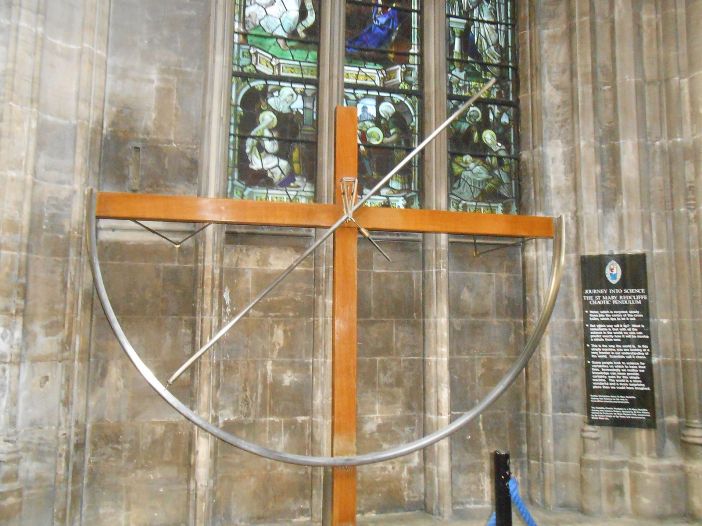
It began with”the fairest, goodliest, and most famous parish church in England,” as the church of St. Mary Redcliffe was described by Queen Elizabeth I.  It’s a Gothic masterpiece, found on a busy street in a gritty part of a city that is slowly finding its way out of a slave-trade inheritance to become a cultural incubator of the arts in the 21st century (including a very popular Wallace and Gromit tour). I was there for a few days last month and one of the very few photos that I took was of the accompanying sign to this water-powered pendulum found in St. Mary’s Redcliffe.  The sign reads:St_Mary_Redcliffe_Chaotic_Pendulum,_Bristol

Journey into Science: The St. Mary Redcliffe Chaotic Pendulum.  It goes on to describe the process of water moving through the cross beams, unpredictably tipping one way or another, and likening that unpredictability to the ways of the world.

In this simple machine you are looking at a new frontier in our understanding of the world.  Scientists call it chaos.  Some people look to science for certainties on which to base their lives.  Increasingly we realize our knowledge can never provide certainty, even for this simple machine.  The world is a more wonderful and a more surprising place than we could have imagined.

Chaos suggests a lack of rules and form, but maybe it’s really just describing an unseen structure or set of rules. Perhaps the water’s flow through the pendulum responds to rules that are beyond human imagination, or forms that haven’t been described yet. I have to think that much of our world, including our music, would seem incredibly chaotic to our ancestors, should they be able to visit us in 2018. Yet we are surrounded by patterns, and our music is based on recognizable progressions. Could it be that there is meaning in those things which we aren’t evolved enough yet to understand?

I’ve been spending some time with the piano music of Philip Glass this summer. To the resistant listener, it probably sounds random, with its repetitive patterns and unpredictable shifts. I am not an expert on his music, nor have I spent hours analyzing it, but I’ve found playing it to be a wonderful way to warm up my fingers and center my mind. The difficulties of his music are not the usual ones – playing the notes isn’t hard, but staying focused and negotiating the subtle moves in the music is.

Things which seem completely random and unrelated can still draw someone into an artistic experience. Perhaps because there are patterns that lie below the surface of seeing which speak to a hidden part of our brain. The works of artist Jackson Pollock, for example, have been analyzed using fractal analysis. Could this same process be applied to the music of Glass ? Does the human desire for patterns and repetition draw us even toward those things which might seem chaotic at first glance?

Image property of the Albright-Knox Art Gallery, Buffalo, NY.

I begin working this week as the Interim Music Director at Church of the Epiphany in Washington D.C., and will be there for the next eight months. Church can, at its best, offer an antidote to life’s chaotic moments, don’t you think? I wonder if I’ll learn that the world is indeed a more wonderful and more surprising place than I could have imagined.

Peace,
Sonya

* * * * *

This blog represents my attempt to put thoughts together on various things that seem to connect – in my mind anyway. More often than not new ideas first involve reaching back to what was and I can only hope that the prehistoric San cave painting at the top of this page inspires all kinds of connections between old and new.

Feel free to pass this message along to anyone who might be interested. You can simply subscribe (look for the “Subscribe” button at the top of the post) to get a reminder of new posts, or you can register with a user name and password in order to comment. If a community conversation comes out of this, all the better. We have so much to share and so much for which we can be grateful.


Can We Talk?

Comedienne Joan Rivers used to ask that during her shows. It was her way of saying that she wanted to be honest with her audience, that it was time to cut through the b***s***.  Unfortunately, plenty of things regularly remind us that, no, actually we don’t seem to be able to talk.

It’s been a fantastic summer for me – with lots of opportunities to catch up with friends and meet new people, to travel and to make music.  As some of you know, I travelled with a small group of singers to a fairly remote part of France this summer, where a parish priest in one of the churches that hosted our concerts was concerned about our program.  He needed confirmation that we would be singing only Christian music.  “Well,” the native French speaker among us reluctantly began, “we will be singing one piece with a Sephardic Jewish text”…”Oh, that is fine,” he told us.  “It is the same God, one God…” and he sped off before she had the chance to tell him that we were also singing a set of pieces based on the Hindu Rig Veda. Many gods in that case, but words that were equally expressive of that same human need to connect with the divine.

More recently, I was talking to someone about an organization of community choirs which she had founded.  She said that there were people in her choirs who refused to sing the word “Jesus.”  The wall between sacred and secular could not be breached it seemed, though I suspect that the wall was actually between a perception of conservative Christianity and everything else.

Can we talk?  Or in my world, can we sing at least about things which are not part of our heritage or our personal piety?

I don’t often quote The Washington Post‘s George Will, but his editorial last week (August 5, 2018) sparked an idea in me that I had long felt to be true. Quoting from a book by Robbert Dijkgraaf, Will wrote about a need to rail against “philistine utiltarianism,” and about the “practicality of unobstructed curiosity that sails against the current of practical considerations.”  In other words, not everything needs to make immediate sense, nor should our ideas and efforts solely follow a narrow path of usefulness. Wonder should not be cheated.

Will was writing specifically about science, but in my own mind I broadened his meaning to include all of those ideas and experiences which add to our understanding of, well, everything. Our institutions, Will writes, should create a “culture of curiosity.” Our institutions – like churches and community organizations, government and universities. We can’t know what will lead someone down the wider path of understanding, but when we tear down walls then conversations happen, and who knows what that might cause us to wonder about.

Fugues are the musical equivalent of conversation, albeit an Italian conversation where everyone is talking at the same time! Just for fun, here is a favorite fugue of mine performed in a way that feels just right for summer: Bach, Fugue in G Minor, BWV 542

Peace,
Sonya

PS  Thank you L.S. for encouraging me to begin writing again! Discipline and inspiration have been lacking of late, but September will bring, I hope, hefty doses of both.

* * * * *

This blog represents my attempt to put thoughts together on various things that seem to connect – in my mind anyway. More often than not new ideas first involve reaching back to what was and I can only hope that the prehistoric San cave painting at the top of this page inspires all kinds of connections between old and new.

Feel free to pass this message along to anyone who might be interested. You can simply subscribe (look for the “Subscribe” button at the top of the post) to get a reminder of new posts, or you can register with a user name and password in order to comment. If a community conversation comes out of this, all the better. We have so much to share and so much for which we can be grateful.